Water Absorption in Natural Stone – What Venetian Builders Knew 700 Years Ago, Long Before Any Standard
A small number on the datasheet can determine whether a facade survives ten winters intact or starts showing frost damage: water absorption. What it reveals about a stone, how it is measured, and why two stones with the same value can behave in completely different ways — from Venice to the EN standard.

Venice in evening light — palazzos that have stood on the Canal Grande for centuries. Built on and from Istrian limestone. Pietra d'Istria: 0.2 % water absorption — that is the real reason these palaces are still standing.
Venice's White Stone – An Istrian Limestone with Low Water Absorption
Venice under a blue sky, the soft evening light enchants every onlooker, and the facades of the palazzos dance as trembling reflections in the water of the Canal Grande. The eye is captivated, and at the same time curiosity stirs: a closer look at the palaces, the bridges, the forms — and the stone.
The walls rise directly from the water. The stone that touches the lagoon and defines the architectural language of the buildings is consistently the same: pale, almost white, washed by water over centuries — a limestone. Used at the Rialto Bridge, at St. Mark's Square, on the facades of the palazzi — a unifying element throughout the entire lagoon.
Reason enough to dig deeper. The Venetian master builders used Istrian limestone from what is now Croatia. It has low porosity, resists salt erosion, and shows high resilience in water-saturated environments — without becoming porous or crumbling. It was used preferentially on the lower storeys of buildings, where direct water contact was constant. Limestone absorbs water. The old master builders knew this precisely.
Where does this appear in today's DIN standards? Knowledge accumulated over centuries — the knowledge that has kept Venice afloat for 700 years — leads back to two unassuming numbers: water absorption and pore saturation.

The Value You Tend to Overlook on the Datasheet
Every technical datasheet for natural stone contains a number that gets read and rarely scrutinised in its full context: water absorption. Sometimes it's 0.1 percent, sometimes 0.5 percent, sometimes over 3 percent. A small number — one decimal place — and yet it is a co-determining factor in whether a facade still looks as good as new after ten winters, or whether the stone begins to show frost damage. And it correlates with several other critical factors.
Anyone who processes or specifies natural stone knows the debate around appearance: colour, veining, surface finish. Water absorption and freeze-thaw cycling rarely enter the conversation at that stage. If these parameters are not addressed at the start of a project, the conditions for damage are already in place. This article explains what water absorption means for a stone and how it is measured — knowledge that should form the baseline for working with natural stone. It does not replace the testing procedures needed to obtain reliable documentation for a specific project.
Water Absorption — The Physical Explanation
Natural stone is not a homogeneous, solid block. It contains microscopic voids — right up to visible cavities. Even dense granite has a pore network, even if invisible to the naked eye. When natural stone comes into contact with water, capillary action draws moisture into those pores. You can usually see this as a shift in the stone's colour: it appears noticeably darker.
To quantify this property, a standardised value was defined: water absorption. It indicates how much water a stone takes up relative to its dry weight when fully saturated under normal atmospheric pressure. Water absorption is expressed as a percentage by mass.
The binding test method is DIN EN 13755. In simplified terms: a standardised test specimen is completely dried under controlled conditions and precisely weighed, then saturated with water under defined conditions and weighed again. The difference in weight, divided by the dry weight, gives the percentage. Worth noting: a stone with 0.1 percent water absorption takes up one gram of water per kilogram of stone — a stone at 3 percent absorbs thirty times as much.
This number is not a laboratory result for the filing cabinet. It is the direct indicator of how open a stone is to moisture — and moisture is the transport medium for almost every form of natural stone damage, both outdoors and indoors.
The Numbers Decoded: From Dense to Thirsty
Natural stones can broadly be grouped into three behavioural categories — with fluid transitions between them:
- Below 0.5 percent — dense. The stone barely absorbs water. Frost has little volume to act on; staining penetrates slowly. Typical values for premium marbles, many quartzites, and dense granites.
- 0.5 to 2 percent — moderate. Requires awareness at the planning stage. Generally uncritical for interior wall cladding, but outdoors it depends on exposure and climate. Many limestones and mid-range granites fall here.
- Above 2 percent — absorbent. The stone draws in water noticeably. Suitable for heavily weathered exterior surfaces in frost climates only with a protection strategy. Many sandstones and porous limestones reach values of 3 to 6 percent.
That said, the value alone does not tell the whole story — pore structure plays a major role. As a first risk indicator, water absorption is the fastest available measure.
Material Comparison with Real Values
The range across material classes is larger than most people expect. An overview with measured values (per EN 13755; sources are manufacturer datasheets and EN test reports):
| Material | Water absorption (wt. %) | Exterior / frost suitability |
|---|---|---|
| Quartzite (dense) | below 0.1 | excellent |
| Marble (premium, crystalline) | 0.06 – 0.20 | excellent to good, variety-dependent |
| Granite | 0.2 – 0.5 | good |
| Limestone | 0.5 – 6 | highly variety-dependent |
| Sandstone | 1 – 6 | only with protection strategy |
Even within a single material class, water absorption separates one variety from another. For premium marble, the range stretches from around 0.06 percent for particularly dense, doubly metamorphosed varieties such as Lasa Bianco to 0.19 percent for pure-white but more open Statuario qualities. That is more than a threefold difference in water absorption — between two stones frequently shown side by side in a showroom.
Choosing a material purely by appearance, without checking water absorption, can prove costly: the difference often becomes visible on site as early as the first year after installation.
Named Varieties with Measured Values
Specific varieties make the range tangible. Values are drawn from manufacturer and trade datasheets as well as an official geological reference; testing is regularly carried out to EN 13755. Datasheet values are averages or indicative figures and do not replace a component-specific test certificate. For large projects, ongoing testing for quality assurance is therefore always necessary.
| Material (variety) | Rock type | Water absorption (wt. %) | Exterior / frost rating |
|---|---|---|---|
| Azul Macaubas | Quartzite (trade: "granite") | 0.11 – 0.12 | very dense, frost-resistant |
| Lasa Bianco | Marble | 0.06 – 0.12 | very dense, frost-resistant |
| Bianco Carrara C / CD | Marble | 0.12 – 0.15 | dense; as a marble typically preferred indoors |
| Nero Impala | Granite (gabbro/norite) | 0.12 – 0.30 | frost-resistant, polish-stable |
| Bianco Sardo | Granite | 0.30 – 0.58 (typ. ~0.40) | frost-resistant, high density |
| Basalt (dense) | Igneous rock | 0.1 – 0.3 | very dense, frost-resistant |
| Diabase | Igneous rock | 0.1 – 0.4 | very dense, frost-resistant |
| Gneiss | Metamorphic rock | 0.1 – 0.6 | dense, generally frost-resistant |
| Granite (general range) | Igneous rock | 0.2 – 0.5 | good, variety-dependent |
| Slate | Metamorphic rock | 0.5 – 0.6 | traditional roofing / cladding stone |
| Jura Grau | Limestone ("Jura marble") | 0.44 | Datasheet: not frost-resistant → preferably interior |
| Jura Gelb | Limestone | < 0.7 | denser than many limestones |
| Travertin Classico | Freshwater limestone | 0.62 (varieties 0.3 – 3.0) | dense varieties frost-resistant; porous ones critical |
| Ibbenbürener Sandstein | Sandstone | 4.0 | Datasheet: frost-resistant (with protection strategy) |
| Tuff | Igneous rock (volcanic) | 6 – 15 | highly absorbent; interior or protected use only |
| Basalt lava | Igneous rock (porous) | 4 – 10 | porous despite being a hard-rock family |
| Limestone (general range) | Sedimentary rock | 0.2 – 10 | extremely variety-dependent |
Water absorption by material class and variety (EN 13755). The range within a class is often greater than the gap between classes. Values are indicative and do not replace a component-specific test certificate.
The table disproves the simple equation "hard stone = dense, soft stone = absorbent". Tuff and basalt lava belong geologically to the igneous hard rocks — yet they absorb 6 to 15 and 4 to 10 percent by weight respectively, more than many limestones. Conversely, Azul Macaubas, traded as "granite" but geologically a quartzite, sits at around 0.11 percent — at the very bottom of the entire scale. And limestone spans the widest range of all: from 0.2 to 10 percent by weight — almost two orders of magnitude within the same rock family. Anyone specifying "limestone" has yet to establish its exterior suitability.
The direct comparison of Jura Grau against Ibbenbürener Sandstein is particularly instructive: the Jura limestone absorbs just 0.44 percent — nearly ten times less than the sandstone at 4 percent — and yet the sandstone datasheet reads "frost-resistant: yes", while the Jura datasheet reads "frost-resistant: no". Here we return to the pore in the stone: it is not the amount of water absorbed alone that determines the outcome, but the pore structure. A well-connected, "breathing" sandstone can outlast frost better than a denser limestone whose fine capillaries fill up almost completely under normal rain.
Two Stones, Same Water Absorption, Different Frost Resistance
Water absorption tells you how much water a stone takes up. It does not tell you how full its pore space becomes in the process. This gap is bridged by the saturation coefficient (also known as the S-value). It relates two measurements: the water absorption a stone reaches simply by immersion under normal atmospheric pressure, and the water absorption it reaches only under vacuum — forced saturation. During immersion, air always remains trapped in a proportion of the pores. Only under vacuum is that residual air drawn out and the accessible pore space completely filled. The S-value is the ratio of the two: free to forced water absorption. An S-value of 0.80 means that under normal weathering conditions around 80 percent of the water-accessible pore space fills with water, while 20 percent remains as an air cushion.
Why this matters for frost: water expands by roughly 9 percent when it freezes. As long as enough free air volume remains in the pore space, growing ice can displace into it — the stone sustains no damage. Only when the accessible pore space is almost completely filled with water can the expansion no longer be accommodated, generating a bursting pressure that destroys the stone.
This is why two stones with identical water absorption can behave in completely different ways. If one has many tightly connected capillaries that fill almost completely in normal rain (high S-value), it freezes apart faster. If the other has fewer, large, poorly connected voids that always retain some air (low S-value), it survives the same frost — at the same percentage figure on the datasheet.
To be on the safe side for a project, freeze-thaw cycling tests to EN 12371 are required.
A note on measurement: the current EN 13755 measures only water absorption under atmospheric pressure. The full saturation coefficient (including the vacuum component) is not delivered by this test alone; it derives from supplementary testing — open porosity to EN 1936 and vacuum saturation.
What to Consider at the Design Stage
Not every project demands the lowest value. What counts is the combination of moisture protection, installation situation, and climate:
- Ventilated rainscreen facade in a frost climate: Freeze-thaw testing is essential. Water that enters the pores and freezes expands by roughly 9 percent — the pressure can fracture even a compact crystalline structure; real freeze-thaw cycles over years cause progressive weathering. The lower the water absorption, the less water is available to drive this process. Important: verify frost resistance to EN 12371.
- Plinths and ground-level zones: Outdoors: driving rain, de-icing salt, prolonged snow contact, and animal urine. Indoors, this zone is also critical, as rising damp and cleaning water attack here first. Request appropriate test data — including potential discolouration.
- Bathrooms, kitchens, heavily used interior floors: Here the concern is staining rather than frost. An absorbent stone will draw in oil, wine, limescale, or iron minerals before you can wipe them away. These deposits settle in the pore space and cause typically irreversible discolouration.
- Dry interior walls and cladding: Water absorption is largely irrelevant here. Room climate should be monitored to avoid condensation; any moisture-related discolouration in this context is almost always reversible.
Summary: A stone with high water absorption is not a bad stone. It simply requires the right installation situation. The mistake occurs when a stone with high water absorption is specified for an exposed exterior facade without any weathering protection and left to face annual freeze-thaw cycles.

Stone Needs: Protection and Sound Construction
A high datasheet value is not a disqualifier — it is a requirement placed on construction and protection. Three factors determine whether an absorbent stone is safely installed: surface treatment, fixing method, and structural weatherproofing.
Impregnation: What It Can and Cannot Do
An impregnation (hydrophobic treatment) introduces water-repellent active substances — usually silane or siloxane-based — into the pore space. These bond to the pore and capillary walls, increasing the contact angle between water and stone so that rain beads off rather than penetrating. The key point: the pores are not sealed. The stone remains vapour-permeable, and moisture vapour exchange is preserved. An impregnation is therefore not a waterproof barrier.
To be technically honest: impregnation does not lower water absorption in the normative sense — the value measured on the untreated stone to EN 13755 remains a material constant. What it reduces is the capillary ingress of liquid water under real conditions, i.e. how quickly and how deeply the stone actually becomes wet once installed. It shifts the risk; it does not eliminate it. And the water-beading effect diminishes over time — UV radiation, weathering, and abrasion degrade the active compound layer. Every exterior impregnation therefore requires a maintenance and reapplication schedule; intervals depend strongly on the stone, the product, and the exposure.
Fixing: Ventilated or Bonded
How a stone copes with its water absorption depends not only on the material but also on the construction. With a rear-ventilated rainscreen cladding system, a continuous air gap sits between the stone panel and the insulation. It removes moisture: water that enters through joints is drained away in a controlled manner, and the back of the panel can dry in both directions. Even a stone with higher water absorption never remains permanently saturated — frost finds less water available. The ventilated rainscreen facade is therefore the established standard system for natural stone on the exterior.
With bonded or mortar-bed fixing, the stone sits in full contact with the substrate. Any moisture that enters or rises can only dry out through the exposed front face; the back face is sealed off. If moisture accumulates there, it freezes in winter at the bond line — with the risk of spalling and delamination. Rule of thumb: the higher the water absorption of the stone, the more critical a drying-capable, ventilated construction becomes.
Structural Weatherproofing
The oldest and most effective protection costs no maintenance product — it is designed in at the planning stage: keep water away from the stone in the first place. This means adequate roof overhangs and cornices that shade the surface and reduce rain exposure; flashings with drip edges and adequate slope that direct water away from the face; and a well-considered plinth detail with a splash-water barrier and a damp-proof course between the plinth and the rising masonry. The ground-level plinth zone is the most critical area — driving rain, lying snow, de-icing salt, and rising damp all concentrate here.
Impregnation or Sealing?
Impregnation and sealing are often treated as interchangeable, but they work in opposite ways. Impregnation penetrates into the pore space and renders the pore walls water-repellent without closing the pores — the stone remains vapour-permeable. Sealing, by contrast, fills and closes the pores and typically forms a closed film on the surface. It physically prevents water ingress and makes the surface shinier and smoother — but is generally not vapour-diffusion-open.
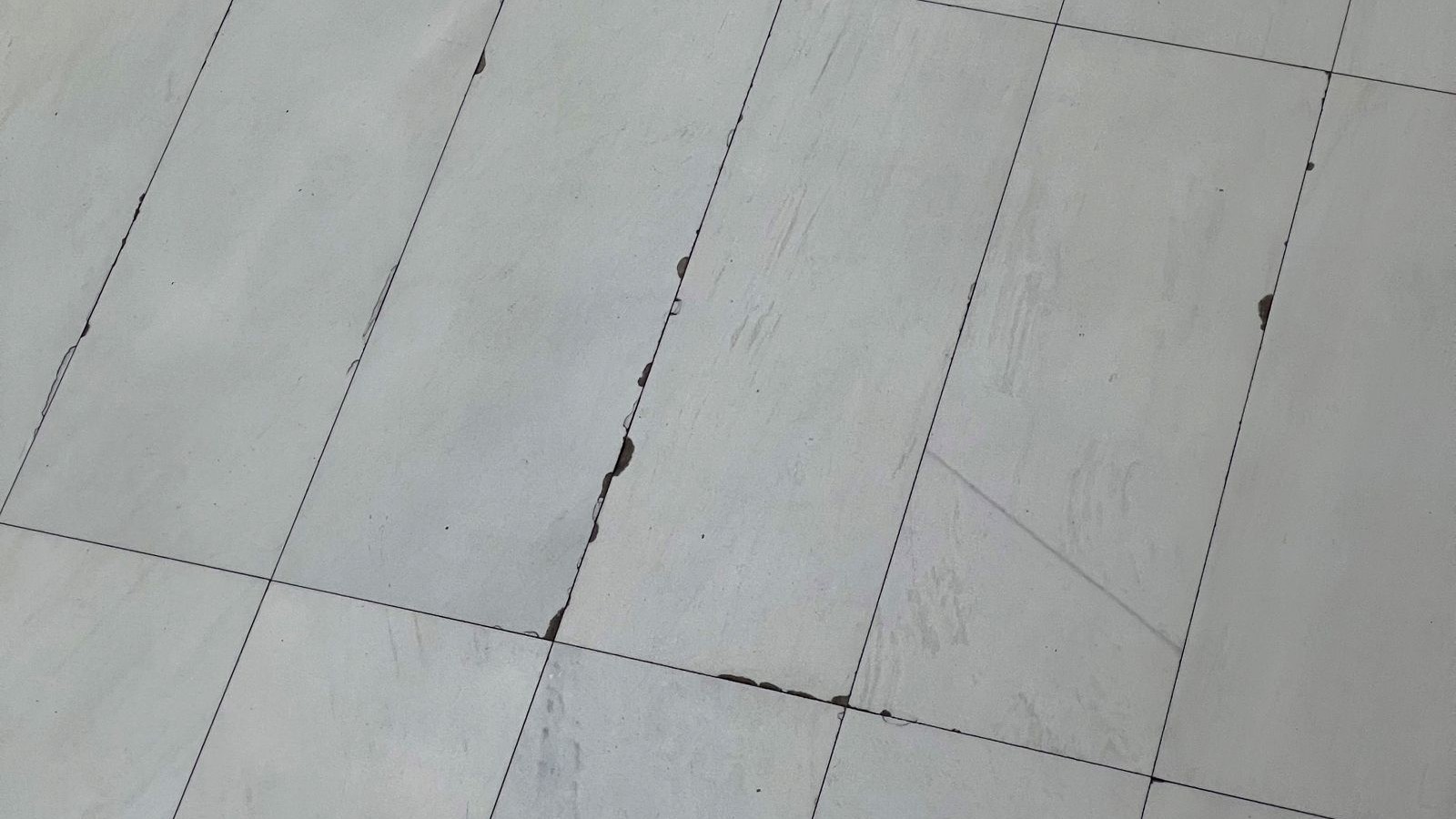
Indoors, the film principle is often appropriate: on a floor, worktop, or staircase, the closed layer reliably protects against oil, wine, and acids, and there is no relevant back-face moisture that needs to escape. Outdoors, the advantage reverses. If moisture is present behind or beneath the sealed surface — rising ground damp, condensation, rain that has entered through joints — it can no longer evaporate through the vapour-tight film. It accumulates, mobilises salts, and freezes there in winter; the film is spalled off together with the uppermost layer of stone. A seal on a weathered exterior facade can therefore cause the very frost damage it was meant to prevent — because it turns the stone into a moisture trap. The practical rule of thumb in stone care: impregnation outdoors; indoors, impregnation or sealing depending on use.
This is reflected in the product ranges of established manufacturers: suppliers such as Akemi and Lithofin offer vapour-permeable impregnations — not film-forming sealers — as their standard protection for absorbent natural stone, exactly in line with the technical recommendation for exterior applications.
A stone with higher water absorption is therefore not automatically the wrong choice. The datasheet value tells you how much care the construction demands — not whether the stone is fundamentally fit for purpose.
Where Knowledge Gets Lost in Day-to-Day Project Work
The real problem is rarely missing knowledge — it is missing visibility at the right moment. Water absorption is on the manufacturer's datasheet. It gets skimmed over during material purchasing and filed away. During specification with the client, appearance is what counts. In project planning, the technical value often never reaches the point where the material decision is actually made.
Working with digital material master data keeps material information centralised and visible alongside the stone — rather than scattered across a PDF in a folder that nobody opens at the critical moment. When purchasing, specification, and project planning all look at the same digital master record, decisions are made with all information in view, not just the colour.
Material Knowledge Where Decisions Are Made
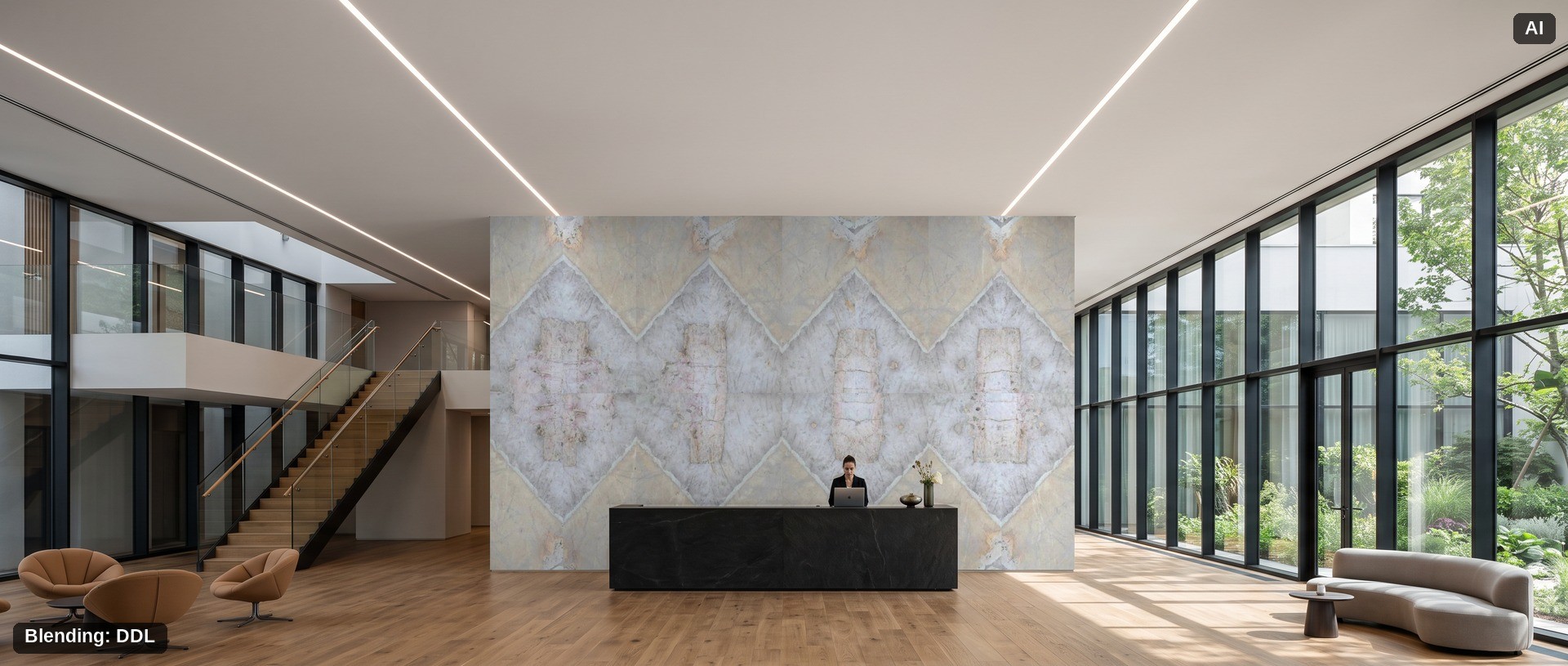
The problem described above is fundamentally a visibility problem: material knowledge is scattered across datasheets, photo folders, and spreadsheets. This is exactly where DDL comes in — every slab and every trade name gets a digital master record with photo, dimensions, and description, searchable by the entire team. That way the information lives with the material itself, not in a folder nobody opens at the critical moment.
Discover DDLConclusion
Water absorption is the smallest important number on a natural stone datasheet. It reveals a great deal about a stone and should always be interrogated in context. Knowing it allows you to identify the project-specific testing requirements earlier, avoiding mistakes in the handling and installation of natural stone. The goal should be to use a beautiful material durably, in the right location, and to its full potential.
Material Data Digital — Not Buried in a PDF Folder
DDL bundles slab inventory and material master data in one searchable system — from the warehouse through specification to project planning.