Natural Stone in Retail: How Storytelling Works in a Flagship Store
In the Jungfrau flagship store in Interlaken, the floor doesn't just sit there — it tells the story of a mountain railway. How natural stone becomes a walkable railway line, what the craft behind it delivers, and why the decisive work happens before the first cut.
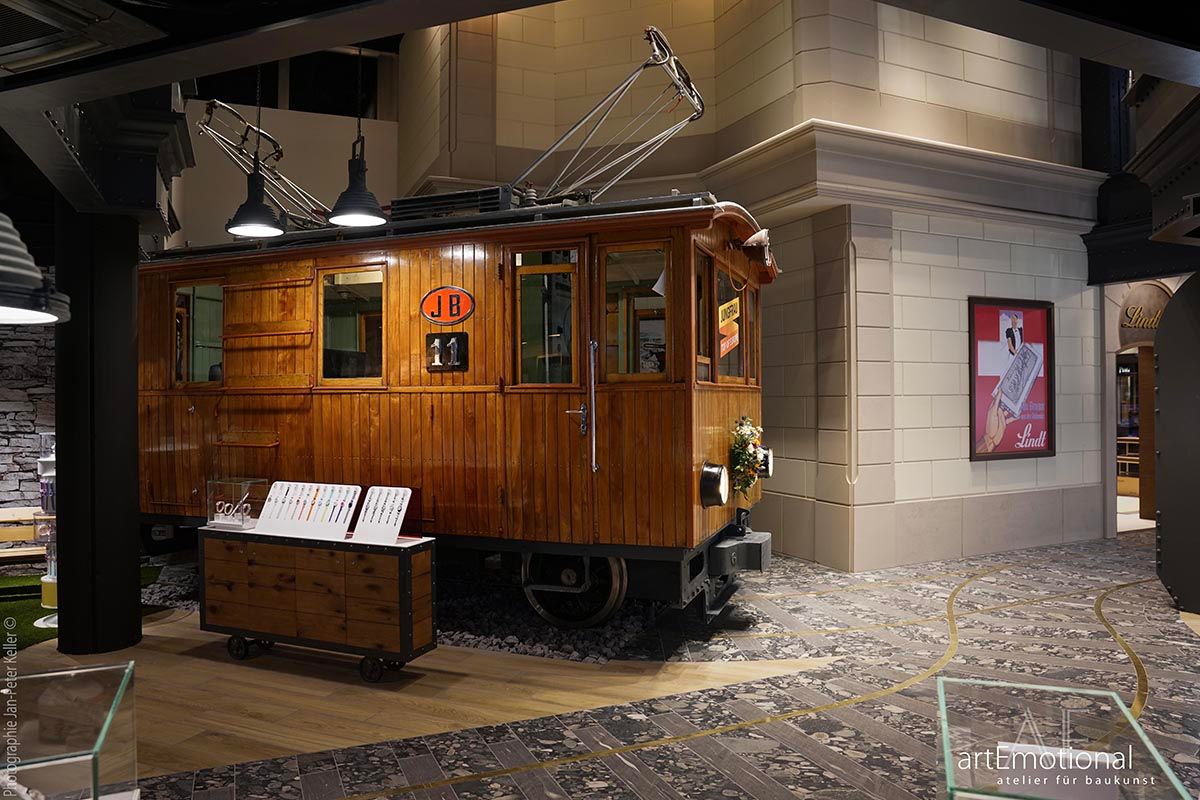
Lok 11 (built 1912) in the Top of Europe flagship store, Interlaken — visually, it sits precisely on tracks made of natural stone. Photo: Jan-Peter Keller / artEmotional.
Walk into the Top of Europe flagship store in Interlaken and you instinctively look down. Because there, set flush into the stone, runs a railway track. Not a printed pattern, not a sticker — a real railway line in brass and natural stone that runs from the entrance to the back, sweeps into a curve, branches at two switches and leads back to the front. You follow it without being asked, calmly, sensing that it will be worth it. That was exactly the intent of the storytelling.
The flagship store belongs to Jungfraubahnen AG, a mountain railway company in Switzerland. You can tell the story of a mountain railway company with posters on the wall and display cases. But you can also make that story immediately tangible, something you feel — with every step visitors take deeper into the store, through the floor beneath their feet.
The floor speaks its own language
In a retail space, the floor is the one surface everyone actually uses. If you want to, you can ignore the ceiling, walk past the shelves, tune out the music — but you stand on the floor. And natural stone is a material that is hard to fake: no décor print, no laminate pretending to be something it isn't. A stone floor is real, it lasts decades, and before a single word is spoken it signals the worth of the brand standing on it.
That is why, in the design I proposed for the flagship store, the question was never whether to lay natural stone, but what it should tell. The Jungfraubahnen go back to Adolf Guyer-Zeller's 1893 idea — a rack railway driven straight through the rock of the Eiger up to the glacier world at the summit of the Jungfrau. That founding story — the track inside the mountain, opening up the mountain, the steep climb — I didn't want to illustrate. I wanted to translate it into material.
A track made of stone: the anatomy of a staged scene
Up close, the line resolves into its components, just like a real railway track:
- Die Schiene ist eine goldfarbene Messing-Linie, fünf Zentimeter breit, bündig in den Boden eingelassen.
- Die Schwellen sind aus Brown Silk, einem Stein, dessen Maserung dem Holz alter Bahnschwellen sehr nahe kommt.
- Das Schotterbett dazwischen ist Marinace Black — ein Konglomerat, das aussieht wie zusammengebackener Schotter, weil es im Grunde genau das ist: rundliche Gesteinsbrocken in dunkler Matrix.
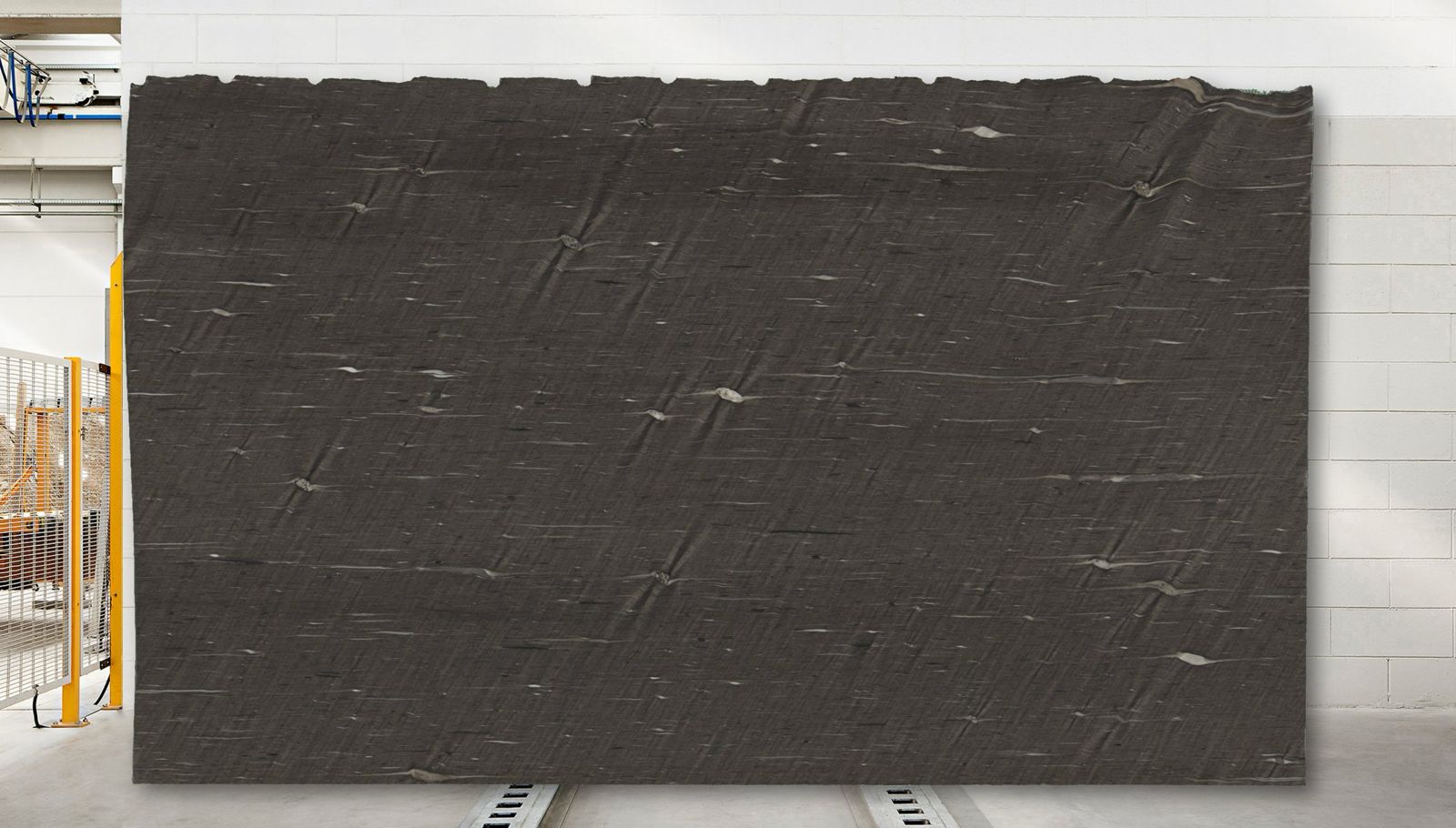
Brown Silk — the sleepers
- Rock type: carbonate gneiss/quartzite (sold commercially as granite), a hard stone
- Origin: Minas Gerais, Brazil
- Age: up to 500 million years
- Appearance: flowing, linear veining with a silky sheen — like fine timber grain
- Finish: honed (matt ground, grit 120)
- Thickness: 2 cm
- Role: the timber-like railway sleepers
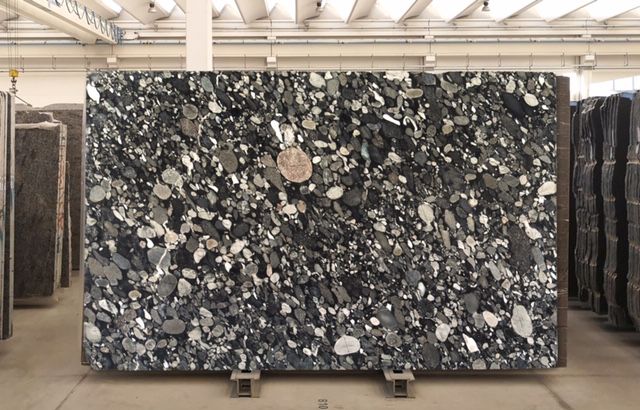
Marinace Black — the ballast bed
- Rock type: metaconglomerate (sold commercially as granite)
- Origin: Minas Gerais, Brazil
- Appearance: a deep-black matrix with rounded pebbles in grey, white and gold — like a petrified riverbed
- Properties: extremely dense, heat-, stain- and scratch-resistant
- Finish: honed (matt ground, grit 120)
- Thickness: 2 cm
- Role: the ballast bed between the sleepers
The stones were selected at two centimetres thick, the floor build-up is 12 cm high overall, and underfloor heating is integrated. The gauge is exactly one metre, and the whole motif is a good two metres wide. Everything is drawn flat into the surface, two-dimensional — no raised rail, no trip hazard. The visual impression of a railway line stays; so does the safety of a level retail floor.
This is the heart of storytelling in stone: not showing off a beautiful material, but building meaning through the choice and combination of several stones. Here the stone doesn't imitate timber and ballast — it quotes them, so the mind finishes the railway line on its own.
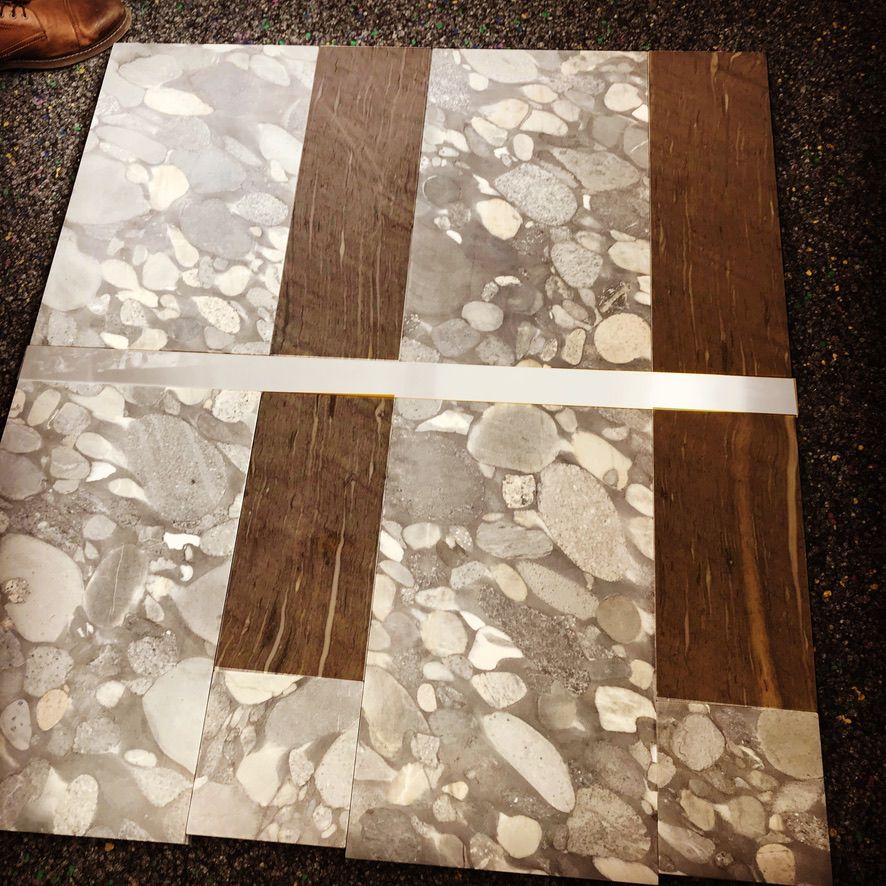
The three elements up close: timber-like sleepers in Brown Silk, the ballast bed in Marinace Black and the brass rail running between them.
The line you have to follow
A railway track has a quality no signpost has: the train follows it inevitably. It runs from the entrance through the whole store, curves at the back, splits at the switches and leads back out — in theory you can walk the entire shop along the rail and end up right where you started.
Stations lie along this line. As on a real mountain railway, you pull in stop by stop at different places — except here they are the Jungfraubahnen's partners: Lindt, Swatch, Victorinox, each with their products at their own station. Signs, stops and an area themed as a railway station round out the experience. The visitor doesn't notice they are being guided. They are travelling.
This is how the emotional bond it is really about takes shape: between the floor, the rail in natural stone, the form of the store and the values and installations of the Jungfraubahnen. The shop doesn't sell products off shelves. It sends customers on a journey. Relaxed and enticing at the same time.
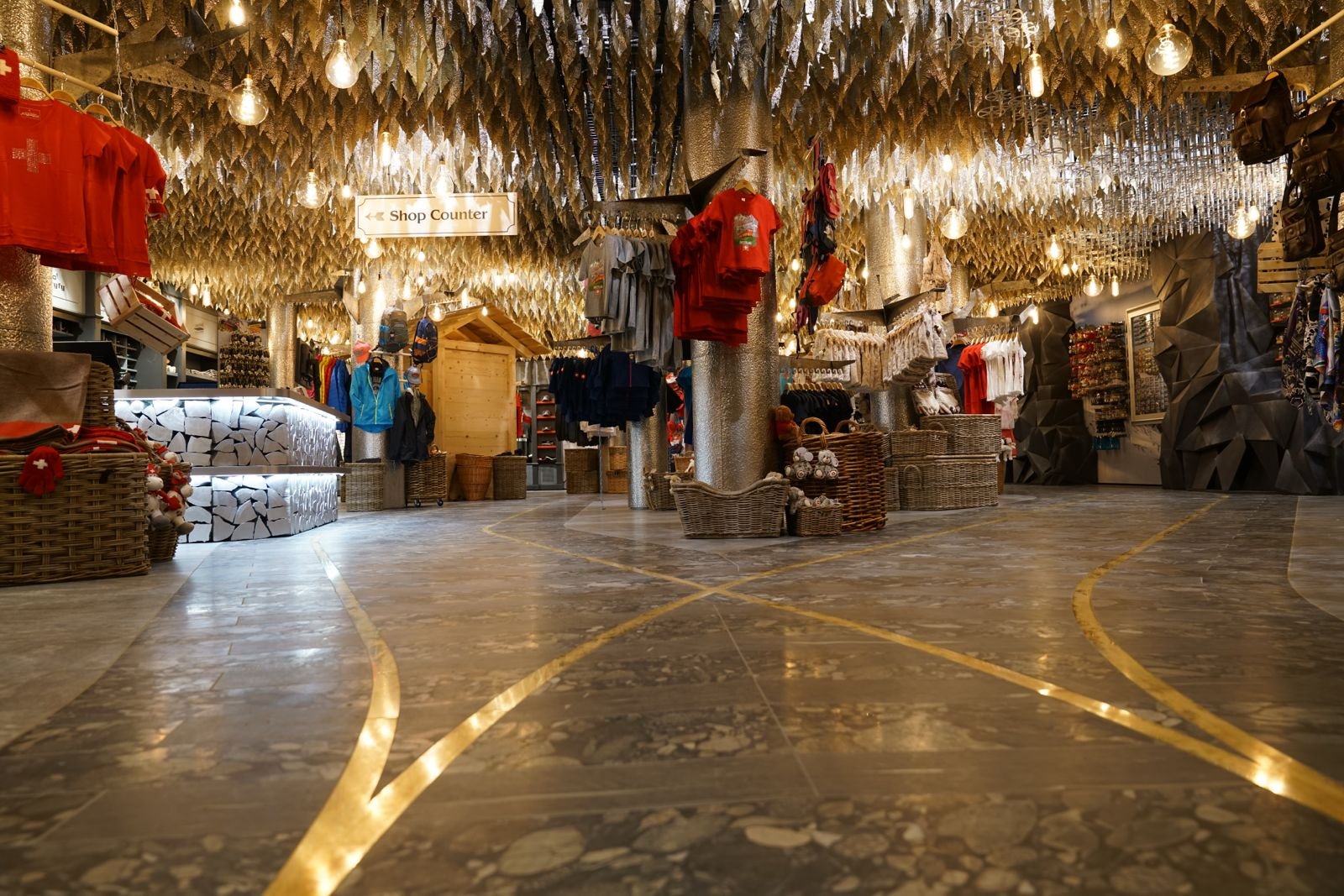
The rail runs right through the store and branches at the switches: brass as the rail, Marinace Black as the ballast, Brown Silk as the sleepers — walkable and slip-resistant.
From 2D to 3D: the locomotive standing on the stone
Visible from the entrance, a locomotive more than a hundred years old stands in the middle of the flagship store — built in 1912, a good five metres long, weighing many tonnes. It was destined for scrap. Yet it is a locomotive with a history — the very same one that in 1936, during the tragedy of the stranded climbers, carried the rescuers rushing to help to the exit in the Eiger north face. We saved it, stripped it out completely inside (today there is an office built into it) and placed it on the line as a matter-of-course accessory.
The crucial part: visually, it stands precisely on the tracks made of stone. The two-dimensional floor and the three-dimensional object meet in the same lane — the story leaps from the surface into the room. Through the stone.
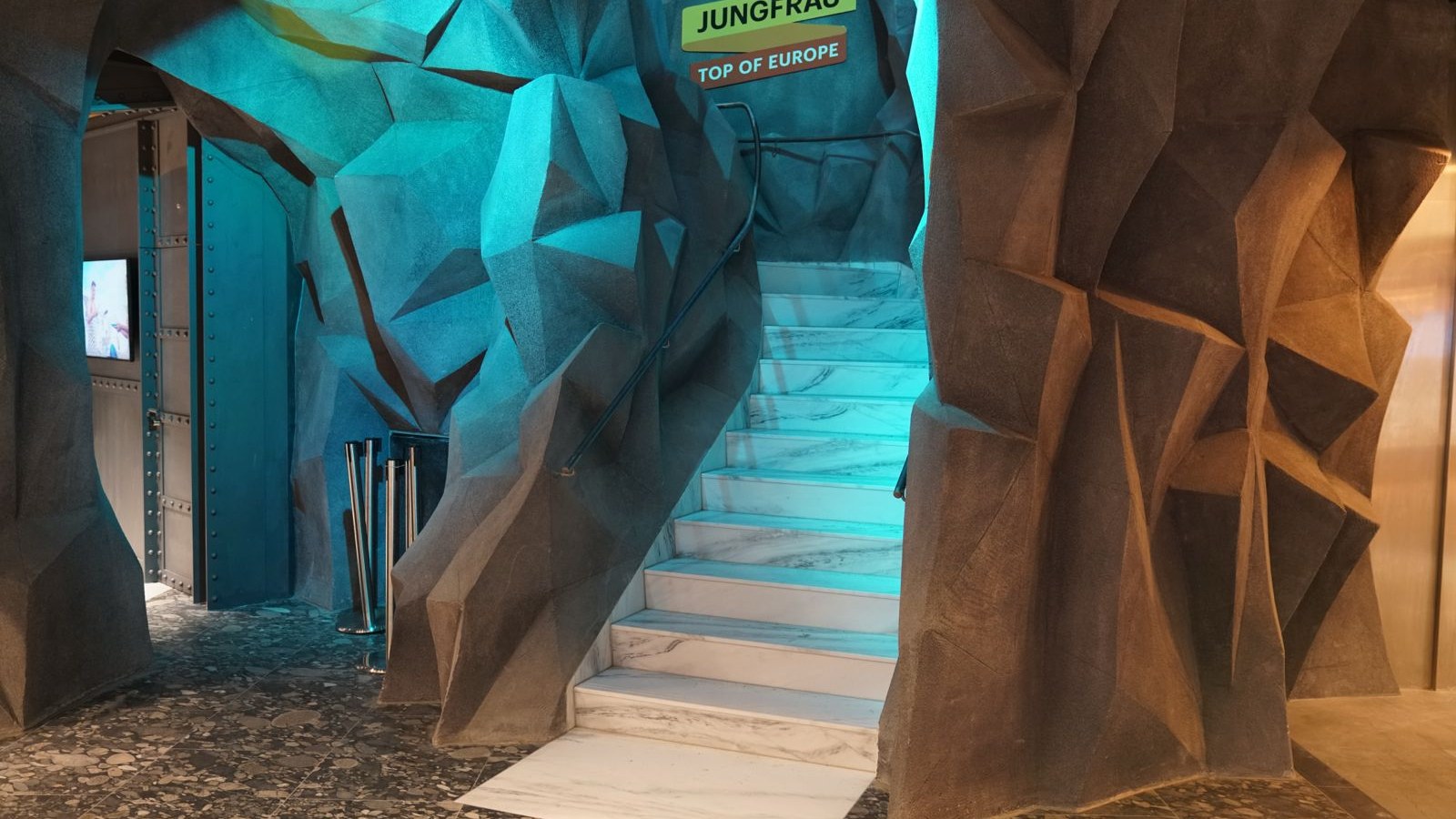
The glacier world joins in one floor up: there, white Lasa marble forms the glacier surface, the stair flight is shaped as stylised rock, the ceiling like ice. The snow-white marble staircase leads straight to the rail, yet it is only a peripheral motif. Throughout the entire ground floor, the lead role stays with the rail.
The craft behind the precision
What looks effortless on the finished floor is the opposite in planning. A straight line is easy: identical sleepers, an identical grid, repetition. But a line with a curve and two switches consists of hundreds of stone pieces, barely any of which is like another. Every curve piece is a one-off, with its own geometry, its own angle, its own number. On top of that come the expansion joints made necessary by the underfloor heating and the size of the line.
On the laying plan, every single piece therefore carries its own identifier — and it is more complex than a simple number: it combines the element type (A to D, four defined base shapes each with their own dimensions), a running number along the line, and a letter for the specific individual piece. That turns A1a, B5d or D20c into an unmistakable address for each of the hundreds of pieces — and every piece also records which edge is finished as the visible edge and which becomes the joint. This grid is densest exactly where the rail curves and divides. Only if every one of these pieces is cut precisely does the rail run cleanly through the curve, meet the switch and close again. A single mis-cut curve piece, and the break jumps straight out at you.
Why this was so hard in 2019 — and is solvable today
When we built the store, DDL didn't exist yet. And that was exactly where our biggest problem lay: transferring the many individual curve pieces into production precisely while keeping the motif in the stone running in the right direction. From the plan to the finished, cut one-off — that path was the real challenge, not the idea.
Today I would no longer set out a track like this by hand, piece by piece. A digital dry layout builds the entire motif on screen and hands every single curve piece to production as an exact cut — before the first cut is made. What cost us time back then would today be a matter of clean planning. This isn't advertising; it's the lesson from the project itself.
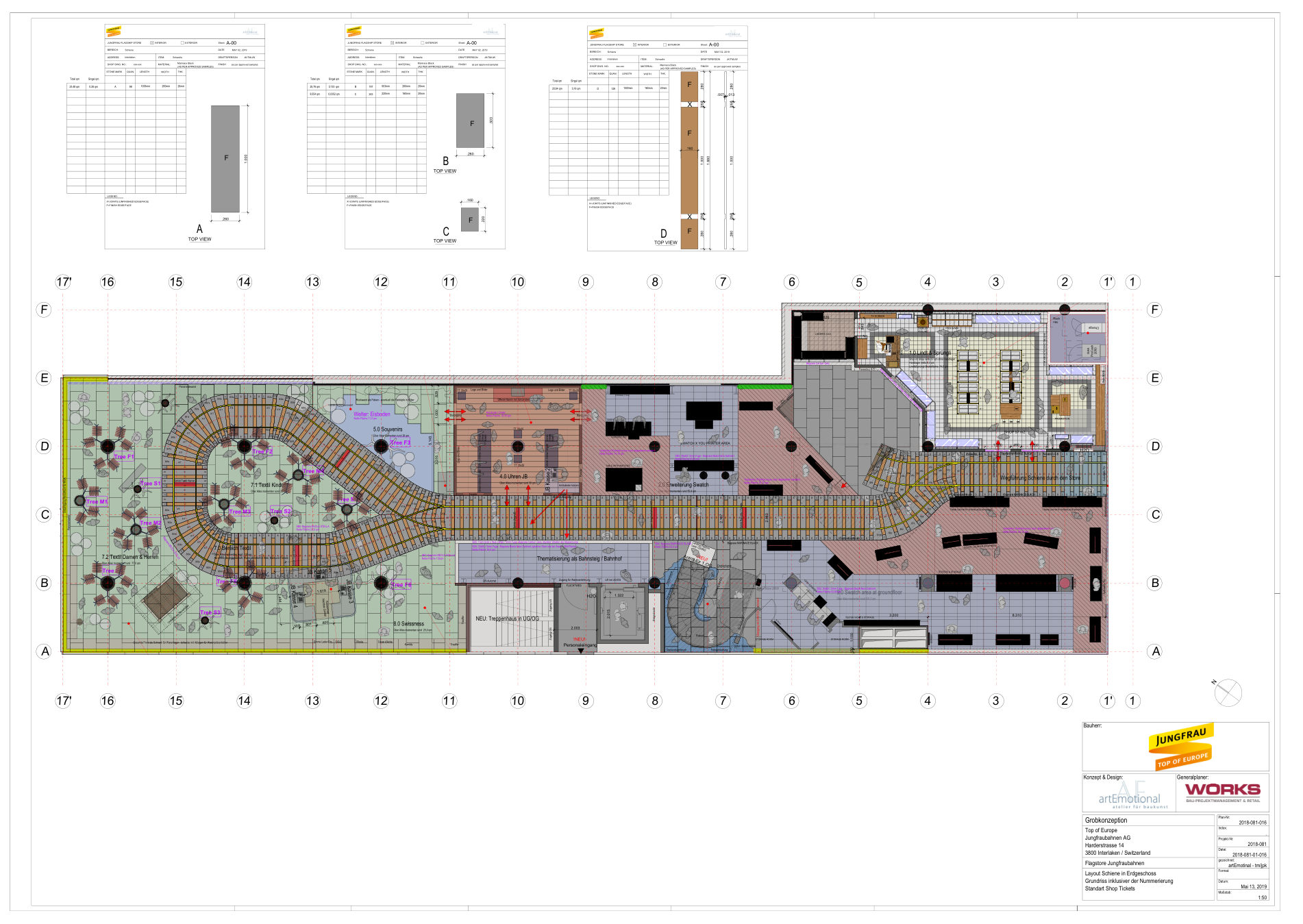
The laying plan for the ground-floor line: hundreds of individually numbered stone pieces, densest through the curve and the switches. Translating exactly this into production was the real challenge back in 2019.
What stone fabricators can take from this
A natural stone floor can be more than a beautiful surface: it can carry its client's brand. Anyone working in commercial projects and shopfitting has a selling point in this that no catalogue material delivers — to brands looking for their story, and to architects looking for substance.
The precondition is precision. An idea like the rail lives or dies on the accuracy with which hundreds of individual pieces come together. Whoever can secure that accuracy from the plan through to the cut can offer stories in stone that others don't dare to attempt.
The floor at the Top of Europe tells a story. It does so quietly, without a single word — and yet every visitor follows it all the way to the last station.
artEmotional GmbH — the studio behind the staging
- Based in: Ettenheim (Germany), founded 2010
- Founder: Jan-Peter Keller (Dipl.-Ing.)
- Focus: mountain railways & tourism, retail, theme parks, hospitality
- Principle: analyse · conceive · build · support — all from a single source
- Guiding principle: "Where visions become stories. And stories become destinations."
- Selected projects: Top of Europe flagship store, Stücki Basel, LOEB Bern, World Trade Center New York
The concept, storytelling and delivery of the Jungfraubahnen flagship store come from artEmotional.