Bookmatched Natural Stone: Guiding the Eye with the Veining?
Arrival at the hotel. At the desk, the receptionist asks about the length of stay, the room preference and breakfast time. Behind her, a carefully executed bookmatch rests on the wall: four mirrored slabs whose veins meet at the joints and come together as one closed motif. This motif holds the eye spellbound.
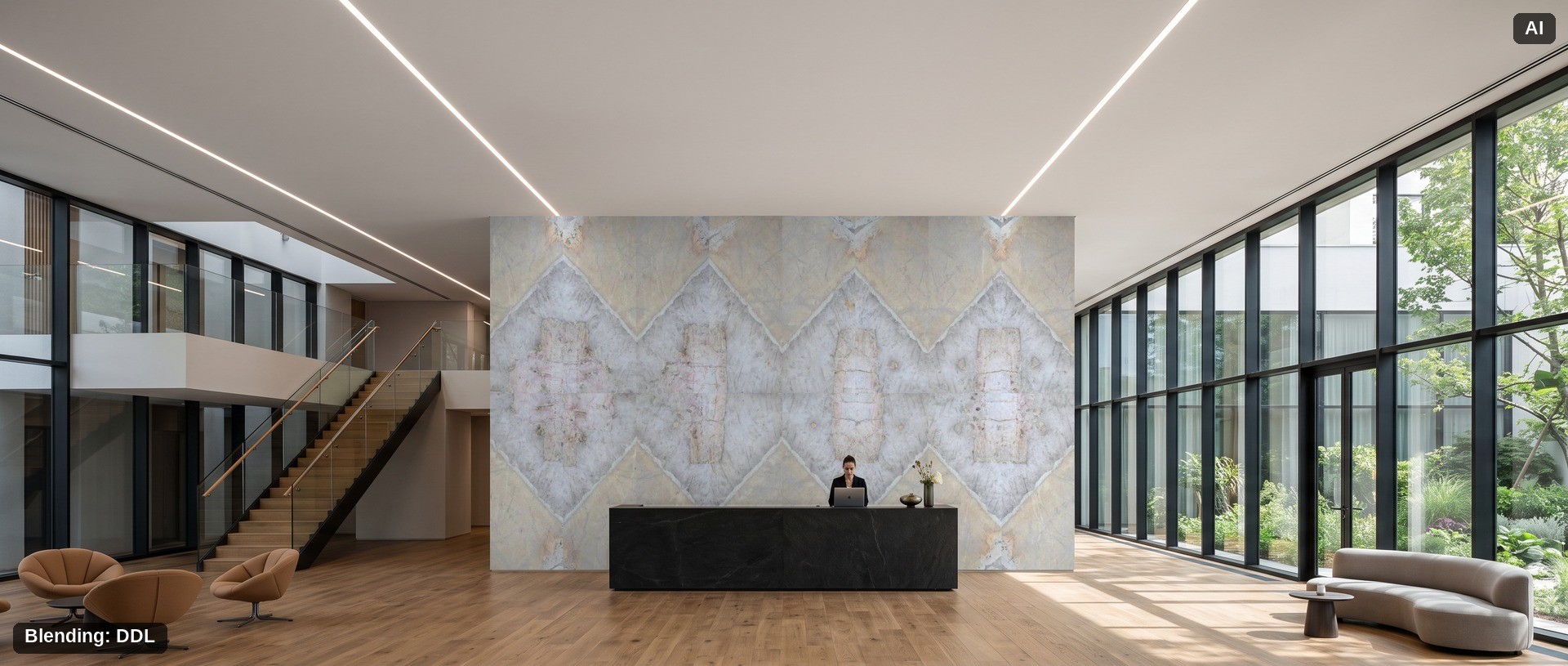
A strong bookmatch has this power. It leads the gaze to its centre and holds it there until one has grasped what it depicts. Standing in front of it, one first wants to take it all in. For a wall that is meant to impress, that is exactly the intention.
At a reception desk, the moment calls for something else: listening, answering, deciding. The attention the stone holds is missing from the conversation.
As a design element, a bookmatch is no accident. It is used deliberately as a statement. How strongly it holds attention is decided by the choice of slabs: a calm material with soft veining lets the eye move on. Expressive slabs with strong character hold it fast.
That is why the choice of slabs matters most where the wall is not meant to stand alone. If the desk stands directly in front of the bookmatch, an expressive stone dominates the attention, and the conversation takes second place.
Why stone is mirrored
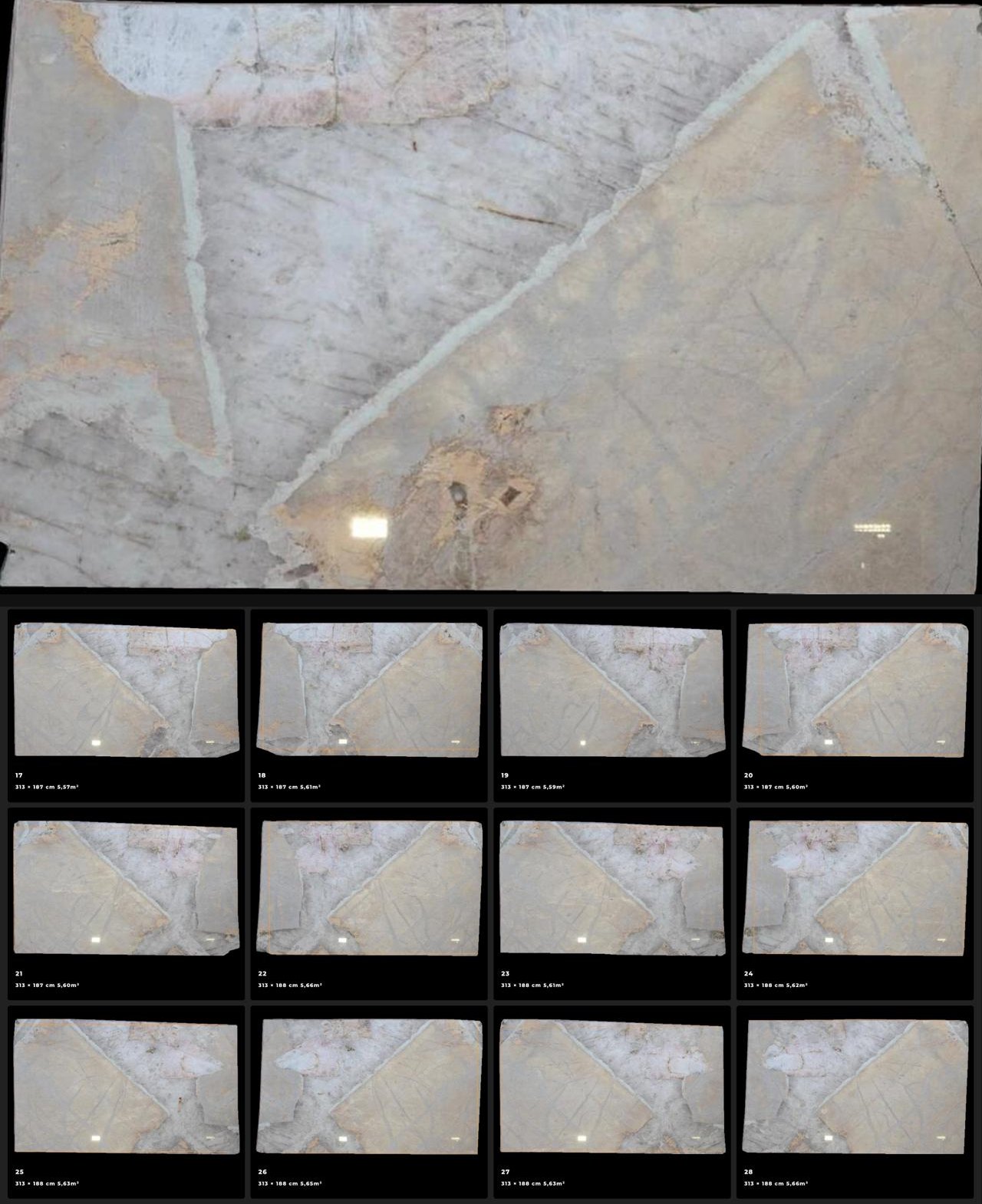
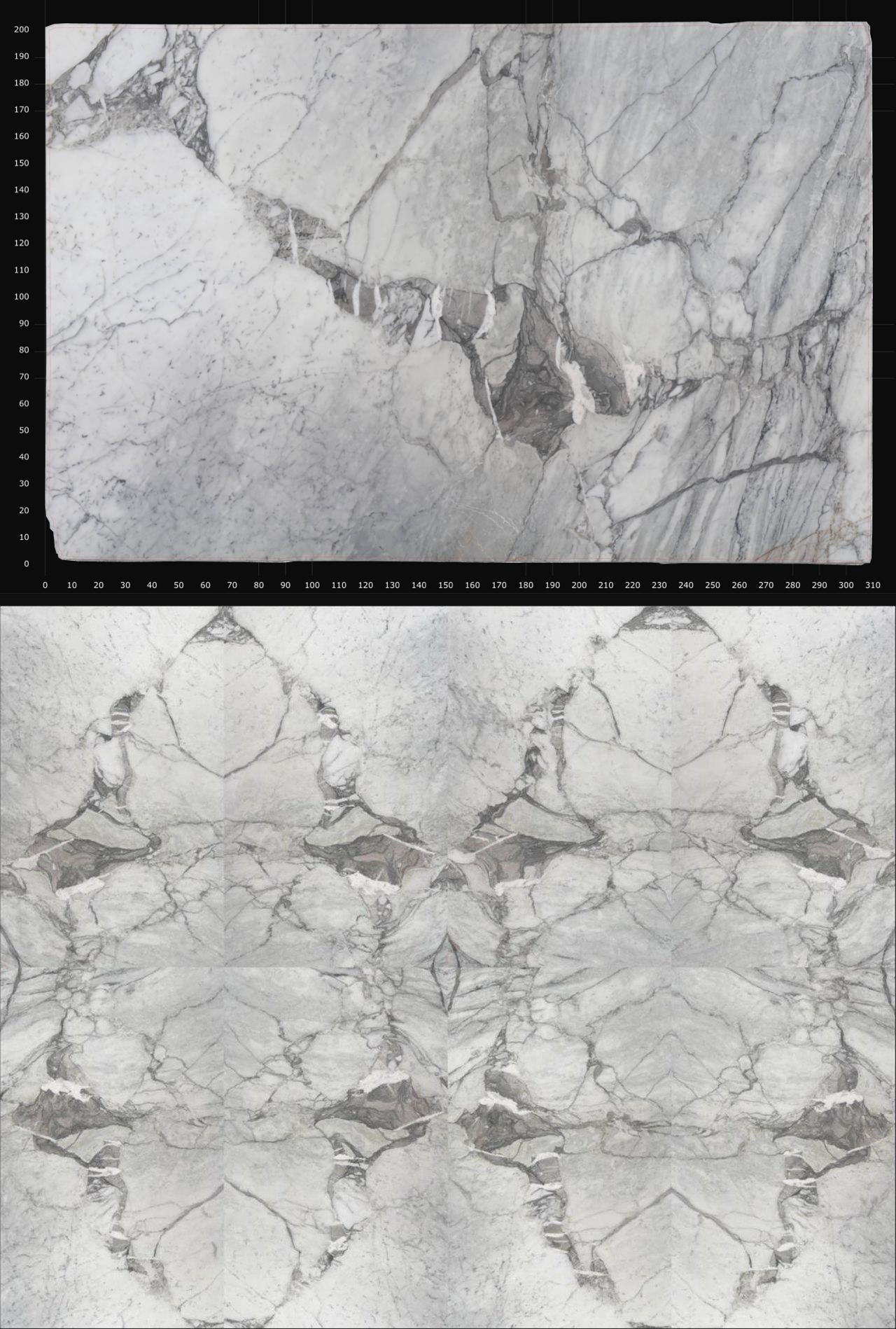
A block is sliced into slabs in sequence. Two neighbouring slabs therefore show almost the same image. For a bookmatch, every second slab is turned over like the page of a book, and only then is the surface finished. This way the face of each slab mirrors its neighbour, and the veins meet at the joint. In a closed bookmatch, the mirroring is repeated along the second axis: four slabs, mirrored left and right, top and bottom.
This is where the motif gets its power. Where two or four halves mirror each other, an axis forms, and the veins run towards it. The eye follows them to the centre. What looks like restless veining when laid at random becomes a legible figure when mirrored.
This effect has been used deliberately since antiquity. In a residential house in Ephesus, researchers examined Cipollino slabs from the 2nd century AD: 40 of them come from a single block and were mounted in cutting sequence as mirrored pairs. Byzantium turned this into a visual language, from Hagia Sophia to San Vitale. How powerful such motifs were is shown by a 13th-century description by Albertus Magnus: in Venice, he saw a sawn marble slab whose halves, placed side by side, showed a king's head with crown and beard. He took it for a work of nature. Even plain varieties such as Proconnesian marble were enhanced by mirroring. Modernism took this up again, with Loos in the Looshaus and with Mies in the Barcelona Pavilion.
Since its beginnings, the bookmatch has been an element meant to draw the gaze. That is exactly why, at a reception desk, it becomes a question of slab choice.
How slabs become a surface
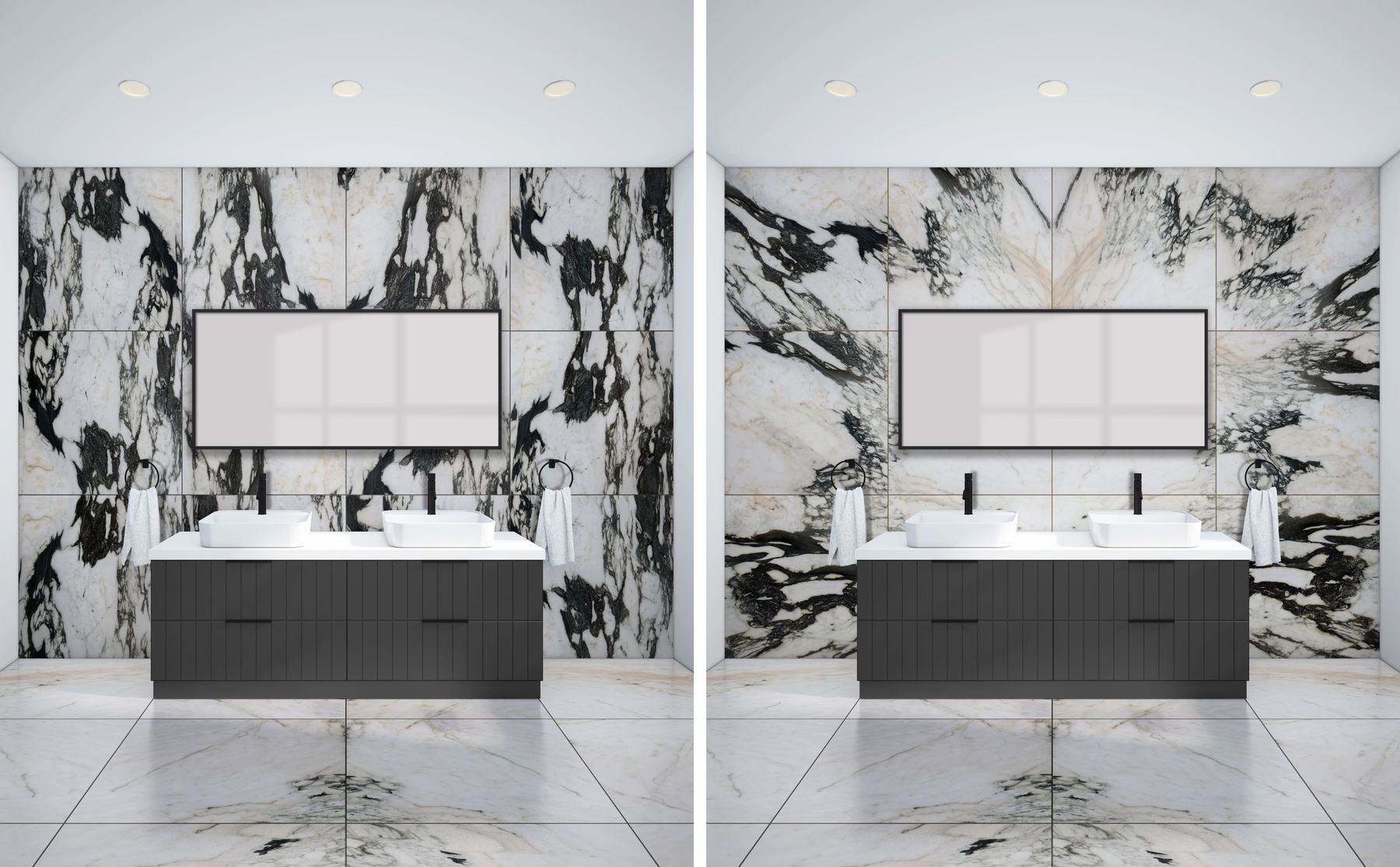
For a wall of strongly veined stone, there are essentially four ways to arrange the slabs. They differ in how much of the order from the block is carried over into the surface.
Bookmatch: Neighbouring slabs are turned over and set side by side as mirror images, in fours in a closed bookmatch. The veins run towards an axis and form a motif. The surface becomes a focal point.
Continuous veining: The slabs lie side by side in cutting sequence, all facing the same way. The veins continue across the joint without mirroring. The surface looks directional and calm.
Laid at random: The slabs follow no order from the block. With calm materials, this is hardly noticeable. With strongly veined ones, a restless chequerboard emerges, because each slab brings its own image.
Blended: Each slab is deliberately given its place, according to colour, vein pattern and character. Strong areas are distributed, calm ones placed with intent, until the surface looks balanced as a whole. This requires an overview of all slabs before cutting.
Behind the reception desk, this is exactly the choice: should the wall show a motif, or should it step back as a balanced surface and give the conversation priority?
The stone up close, the motif from afar
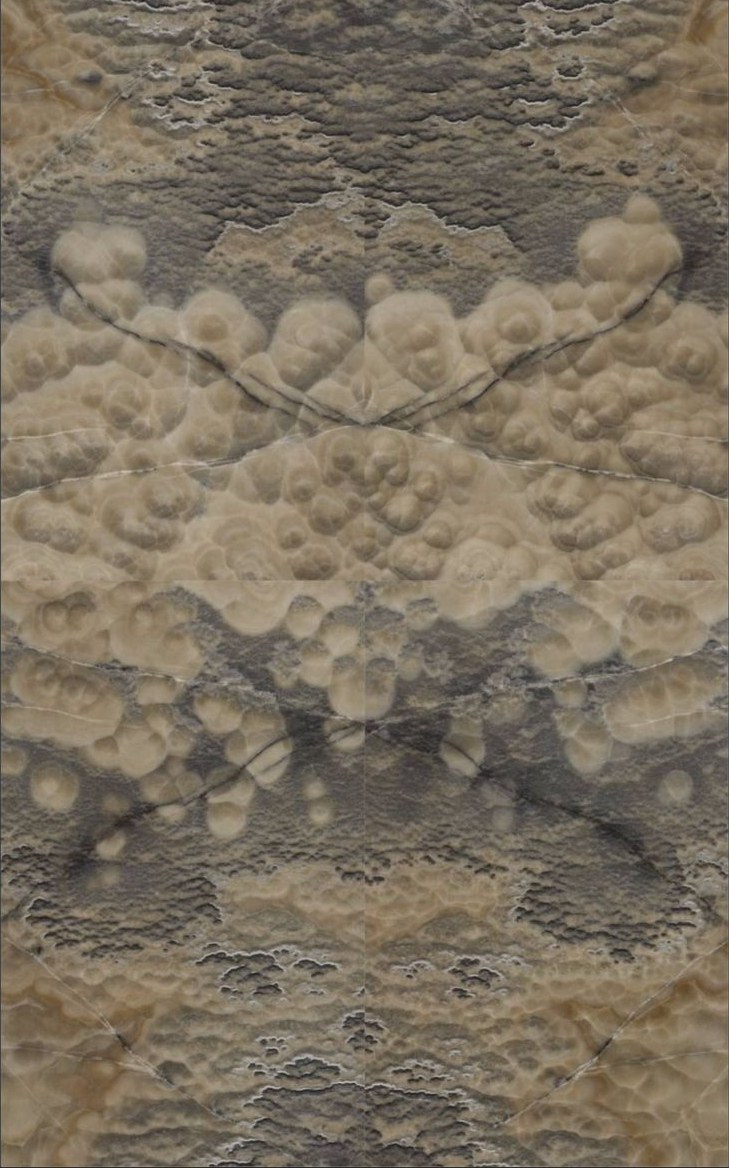
Every slab is inspected up close, for cracks and flaws. There the stone shows its true structure: crystallinity, veins, every irregularity. Its effect as a motif only emerges from a distance.
How much distance depends on the format. Large-format slabs of around two by three metres produce bookmatch motifs up to six metres high, depending on the arrangement. Such a motif needs a corresponding distance to be read as a whole.
Behind the desk, what stands in front of the wall also matters. A piece of furniture, such as a sideboard, means the wall only begins to take effect at around one metre in height. In front of it, the receptionist works. Planning a bookmatch here means checking the picture as a whole: desk, person and stone, their heights and the sightlines.
Where a bookmatch shows its strength
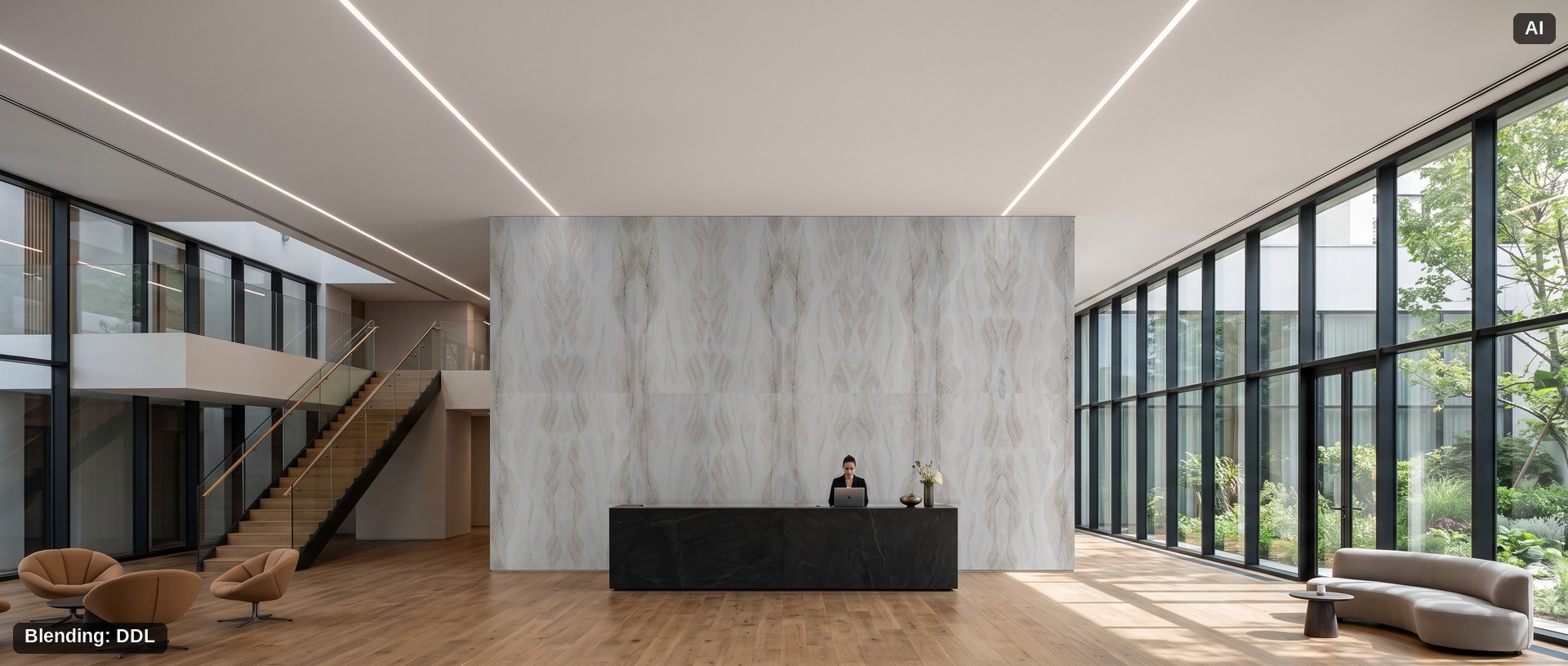
How large a bookmatch can be is determined by the room it is planned for. Lobbies, reception areas and prestigious living spaces are, as a rule, designed large and high. A lobby six, eight or ten metres high can carry even a very large motif. A bedroom rarely reaches such heights; there, a bookmatch of this size simply cannot be executed.
A bookmatch that runs from floor to ceiling demands particular care. It is planned as a closed image, and anything standing in front of it covers part of it. Designers therefore usually coordinate the furniture plan and the slab layout: the bookmatch begins above the top edge of the furniture, so that its motif remains fully visible and the centre the veins run towards stays in clear view.
It is at its strongest where the room is designed around it: as a free wall planned as a focal point, or as a pair of opposite walls whose mirroring picks up the symmetry of the architecture. With strongly veined stones, the bookmatch reveals the full expressive power of the material: mirroring condenses the veining into an image that no single slab can show.
Behind a desk, a bookmatch is therefore not taboo. It simply requires that its size and height suit the room.
From design to wall: securing the design intent before the cut
A bookmatch begins with the designer: with an idea, a material and an image of how the wall should look. Then begins the search for the stone that can deliver this image.
For large projects, a specific block is selected for this, sometimes several. It is gang-sawn, and the surfaces are finished as mirror images. For smaller projects, suitable slabs are selected and bought individually.
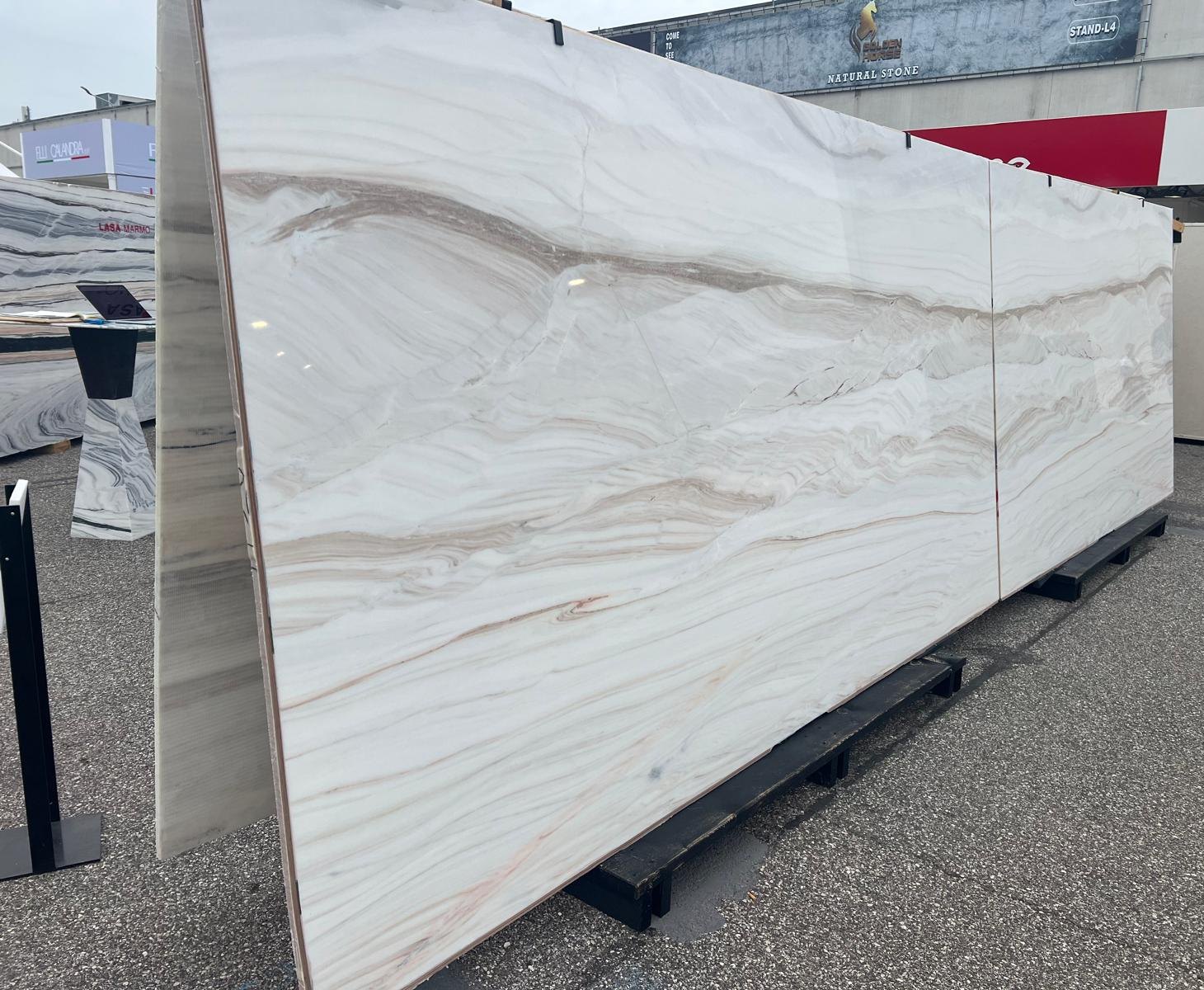
In both cases, what the wall will show is fixed as soon as the raw slabs are cut. Today, this can be checked beforehand. The raw slabs are laid digitally and to scale on the plan, and bookmatch or blending are tried out in variants. The cutting format can be adapted to the raw slabs to give the bookmatch a stronger expression, within the limits set by wall area and room height. Only when the image matches the design does the data go to cutting.
The second part of this series shows how this works in detail.
Explore DDL Solutions
Plan the bookmatch before cutting
A short conversation with Jan Keller clarifies whether an upcoming project can be tried out before cutting.