Natural Stone Specification for Architects: From Range Definition to Sign-Off
Every office has a material library — catalogued samples from 6×6 to 20×20 centimeters. For tiles, ceramics, and engineered surfaces, that works. For natural stone, it does not. Why a hand sample is only a starting point, and which factors determine cost, schedule, and final outcome.
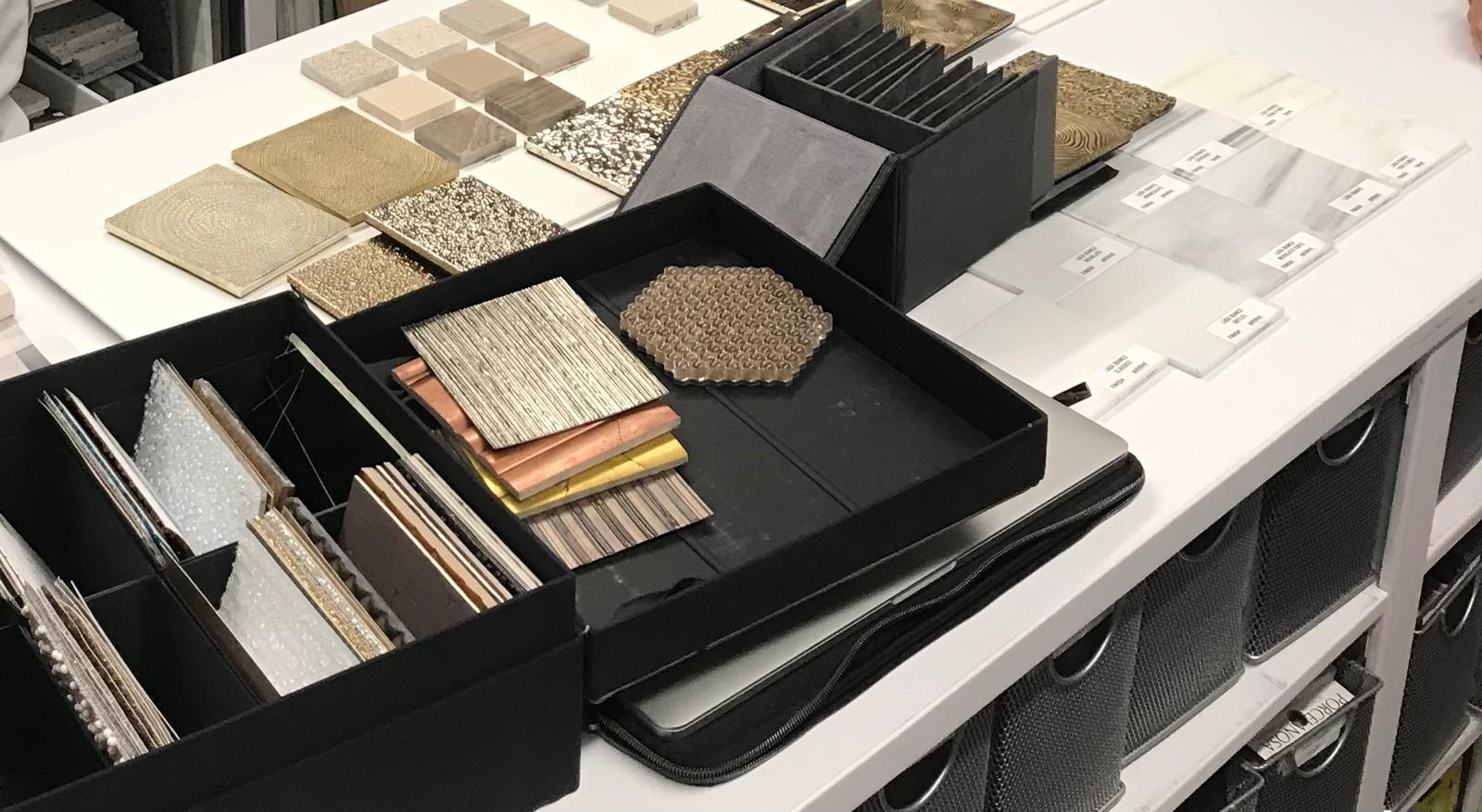
Why the Material Library Falls Short for Natural Stone
Architects and designers build their material selections from the sample library. Catalogued specimens — 6×6 centimeters to 20×20 — sorted by manufacturer, color, finish. For industrially produced products, this is a reliable approach: tiles, ceramics, engineered stone. The sample matches the product because the manufacturing process is controllable and quality is reproducible.
For natural stone, this principle breaks down. Natural stone is not absolutely homogeneous. The blocks extracted from quarries show color variations, tonal shifts, and structural changes rooted in the geological history of the rock. And these characteristics evolve over the lifetime of the quarry. A quarry operates for decades, extracting from different positions in the mountain — what was harvested five years ago can differ in veining, color depth, and structure from what is available today.
This means a sample in the library, three or five years old, represents material from a quarrying zone that may no longer exist. In principle, a natural stone stays true to its character. But the intensity of veining, the crystal structure, can shift. The base color may run slightly warmer or cooler, the texture somewhat coarser or finer. For a kitchen countertop, that is immaterial. For a project with 1,000 or more square meters — a hotel lobby, a facade, open foyers — it determines the overall visual result.
A hand sample from the library is therefore an indicator — a starting point for the material concept. Nothing more. The actual specification process begins after that.
Range Definition — the Most Important Decision in the Project
What Range Actually Means
Range describes the acceptable bandwidth of a material within a project. During range determination, areas are excluded based on natural imperfections, defining which bandwidth of the selected stone is usable for the project. Defining the range simultaneously means defining the price.
Tight Range, Higher Cost
A tight range specifies very precisely which veining, which colors, which inclusions are accepted in the project. That determines the yield from the available raw slabs. The tighter the range, the more selectively material is chosen, the lower the yield. The stone supplier must source more selectively — slabs that fall outside the range remain unused and must be sold elsewhere. In some cases, the range restriction also limits available slab sizes: if only 60 centimeters lie between two dominant veining layers, no slab of 120×80 centimeters can be extracted from that area. A tight range always increases project cost — which is why the conversation with the supplier matters: what does the project cost at this range, and what at a wider one?
Wider Range, More Natural Result
A wider range opens up more possibilities to represent what nature created millions of years ago. That is always a design decision as well. More variation means higher yield from the available material — and a noticeable cost reduction in the project. The skill lies in jointly defining a range that meets aesthetic standards while accepting the small, nature-given imperfections of natural stone slabs.
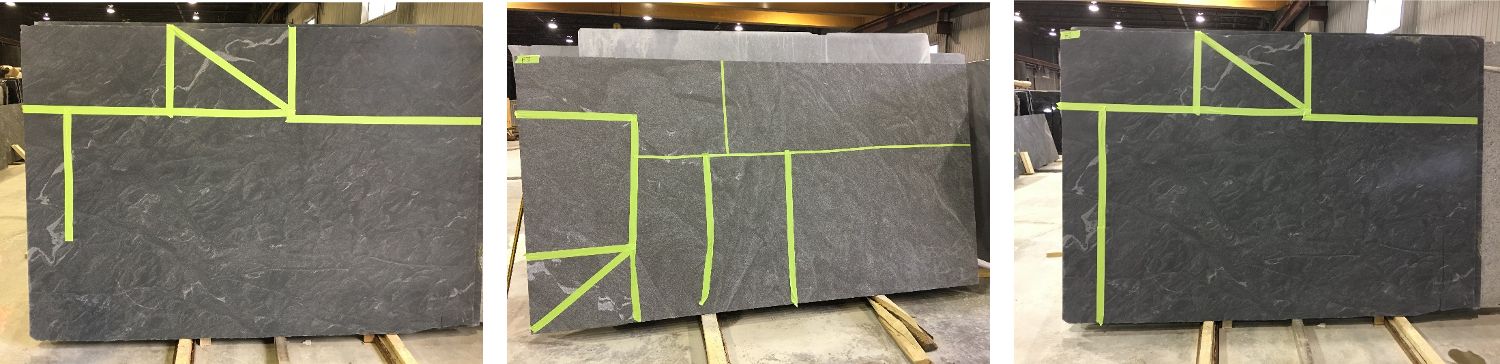
Cut planning on raw slabs: the green markers show how project pieces are placed on the available material. Here, the range decision is made laboriously by hand on each individual slab — a cost-intensive step that can be executed more precisely and faster with digital solutions.
From Sample to Full Picture — Mock-Up and Dry Layout
The range is defined, the slabs are selected. The next question: how do they work together? A sample shows a material. A mock-up shows a project.
A mock-up is typically an area of approximately 20 square meters within the project, where the planned cut sizes are produced and laid out at full scale. The mock-up ensures that the range previously defined in miniature has been correctly understood and implemented by the stone supplier. At the same time, it verifies whether the formats envisioned by the architect are actually achievable from the naturally given raw slabs at that size.
Physical dry lay goes one step further: slabs are laid out after cutting, rearranged until the composition works, photographed, and sent to decision-makers for sign-off. This is effective — but logistically demanding, ties up floor space, and extends delivery timelines. If a slab breaks during packaging or installation, a complex process begins to source replacement slabs with satisfactory appearance and install them in place of the broken ones.
Digital dry layout moves all of these steps to the screen. Slabs are arranged via drag and drop — they weigh nothing, it can happen at any hour, from anywhere in the world. The result: high speed and design precision without logistical overhead.
How digital dry layout works: every slab is captured as a high-resolution image, with dimensions and material data. The arrangement can be changed in minutes — not hours. The architect sees the full composition of slabs within the design, cut pieces in their correct positions, and can evaluate how imperfections in the stone interact with the design concept — sometimes with a very positive effect.
When layout is done digitally, significantly more harmonious transitions between individual slabs can be achieved. This means areas that would previously have been excluded from the range — out of concern for harsh transitions — suddenly work within the overall composition, creating uniqueness without flaws. The range typically becomes more open and better, the overall image more natural. For architects and designers, this represents a major opportunity: working with natural stone far more effectively in the spirit of sustainability, increasing yield — which reduces project cost. Instead of a calculated yield of 60 percent, over 80 percent becomes achievable. That can bring the stone that initially seemed beyond budget back into the project.
Digital Specification in Practice
Tools like DDL (Digital Dry Layout) make it possible to run the entire specification process digitally — from slab digitization through range definition to architect sign-off. The result: specification becomes visual instead of verbal, approvals can happen remotely, and documentation is generated automatically.
Learn more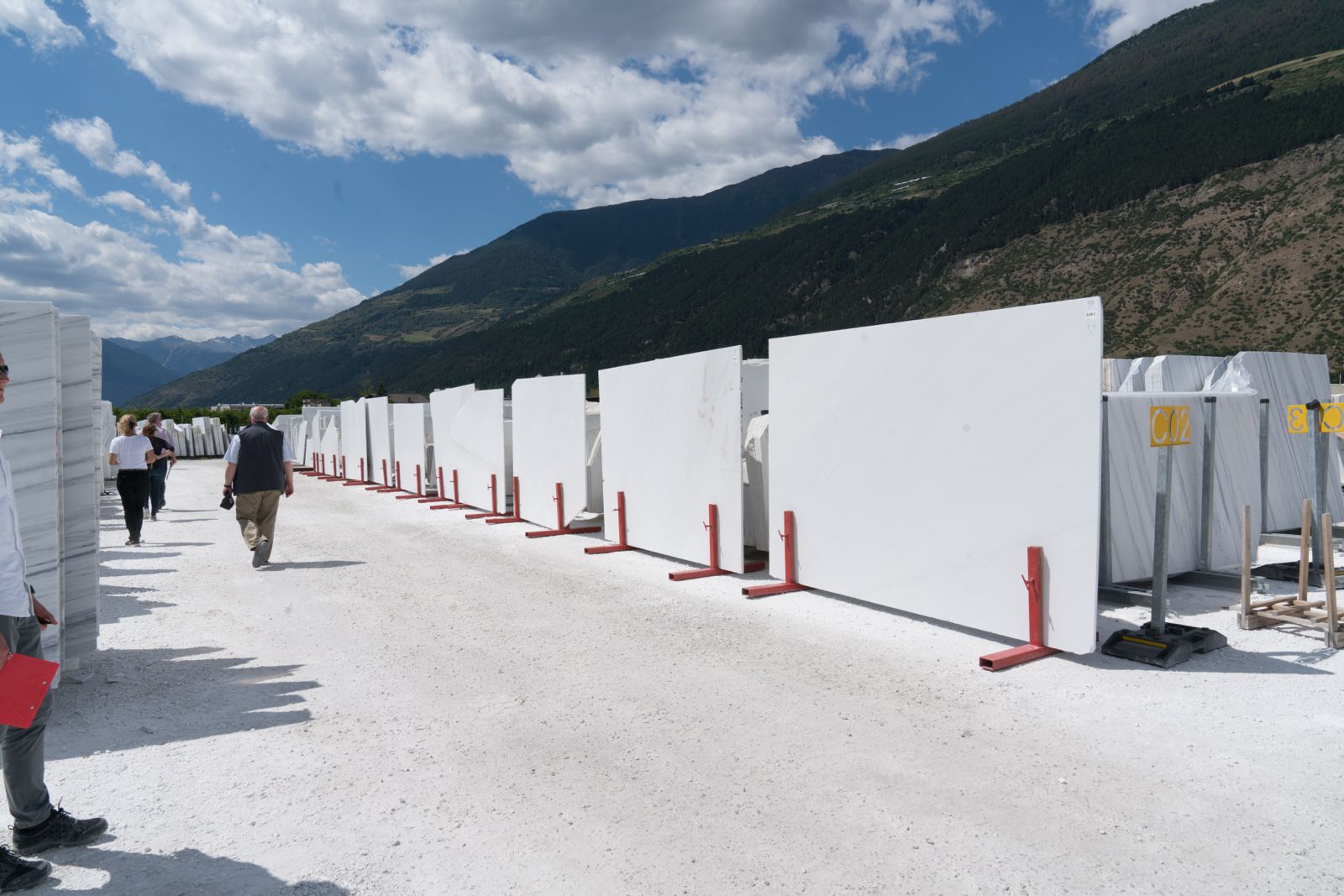
Manual range specification
The slabs are stood upright at the stone supplier, and the range decision is made directly on the material — what is usable and what is not. Add the time investment that often involves travel — project stakeholders sometimes fly in from overseas to review slabs. This is significantly more cost-intensive than necessary today to define the range within a project. Nowadays, this step can be prepared digitally: based on the digital pre-selection, the mock-up described above is produced. Then all stakeholders come together at the supplier, evaluate the physically cut mock-up, and make final adjustments before the full project begins.
Sign-Off and What Cannot Be Changed After
Approval Based on the Full Layout
Sign-off is based on the mock-up or the digital dry layout — not on individual slabs. The architect sees the interplay of all slabs in the project context: veining continuity, color transitions, joint pattern. Only when the full composition is approved does production begin. This sign-off is binding — it defines the visual standard for the entire project.
Documentation Before the Cut
A cut is irreversible — a cut slab cannot be returned to the block. During project preparation and documentation, it is ensured that slabs are cut to the correct dimensions. Here, digital processes are a decisive advantage: through digital dry layout, clean documentation is created all the way to the machine. Every slab is linked via its barcode to the exact cut data. At the same time, digital processes provide seamless tracking — when was what decided and signed off by whom. This gives clear answers to questions after the fact, making the process significantly easier for all stakeholders.
Changes After Cutting
In principle, changes to cut material are only possible to a very limited extent — pieces can only be made smaller, processed into smaller parts, with the corresponding additional labor. A cut slab can typically only be rotated 180 degrees and swapped with one of the same format. With varying dimension layouts, positions are fixed — a larger slab can at most be moved to a smaller position, but must then be recut in one or two dimensions. This generates additional costs at the stone supplier and is uneconomical. That is why the quality of planning before the cut is decisive.
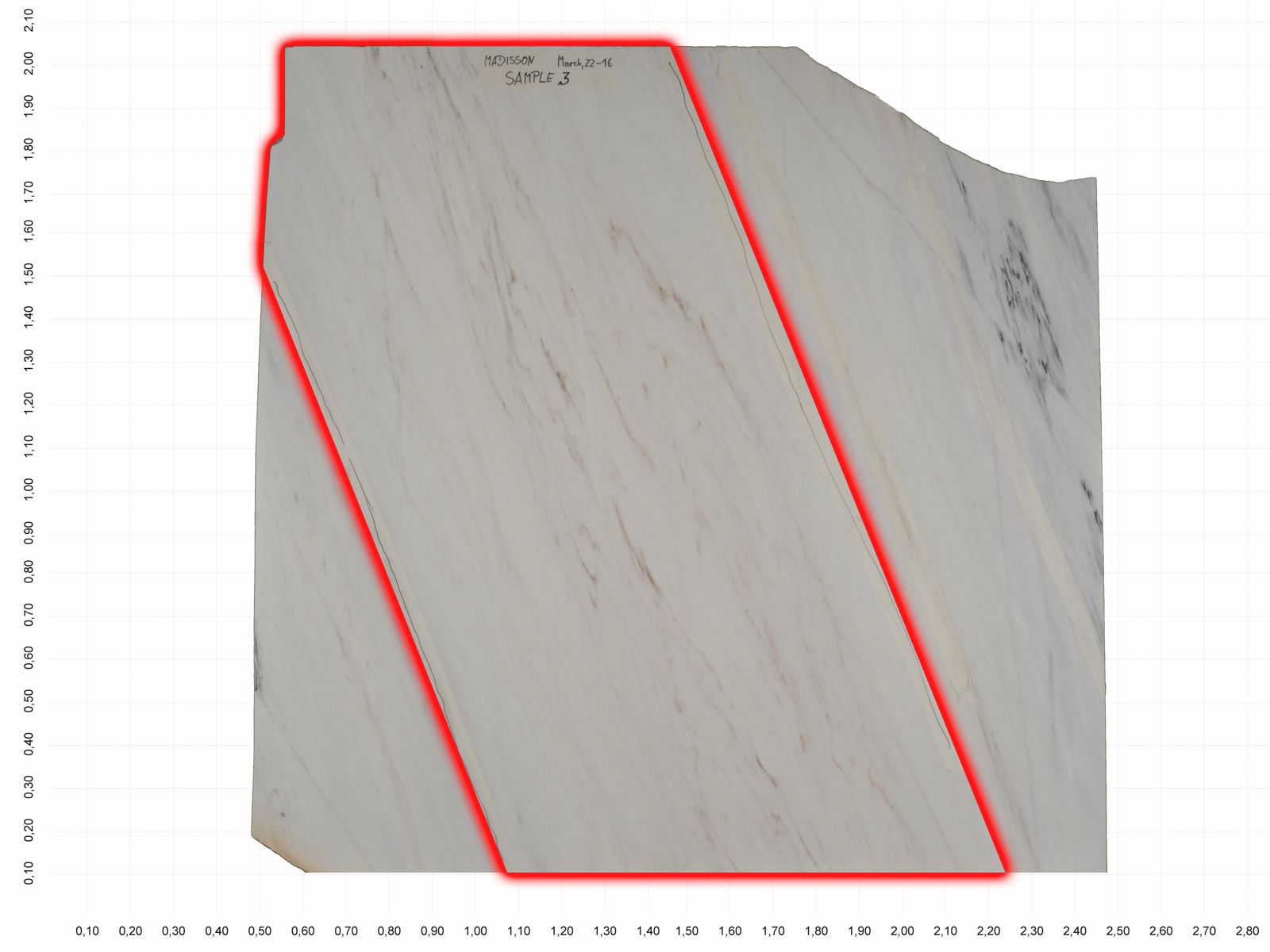
Traditional documentation: slabs were marked by hand with range annotations, then processed via photo and scaling so the range was available as a PDF for all project stakeholders.
What Changes When Specification Becomes Plannable
The specification process for natural stone is not a formality — it is the bridge between design and built work. Done right, it prevents cost overruns, disputes, and the quiet disappointment when the result does not match the rendering.
Define the range deliberately. Review the full composition through digital dry layout before cutting begins. Document approvals. These are not new ideas — but they are skipped in practice with surprising frequency. The consequence: more effort and more cost on both sides. The tools to prevent this exist. But the mindset of "we have always done it this way" means they are still used far too little in practice.
For architects who work regularly with natural stone, an early dialogue with the fabricator pays off — starting at the design stage. That is the moment when cost and outcome can improve simultaneously.
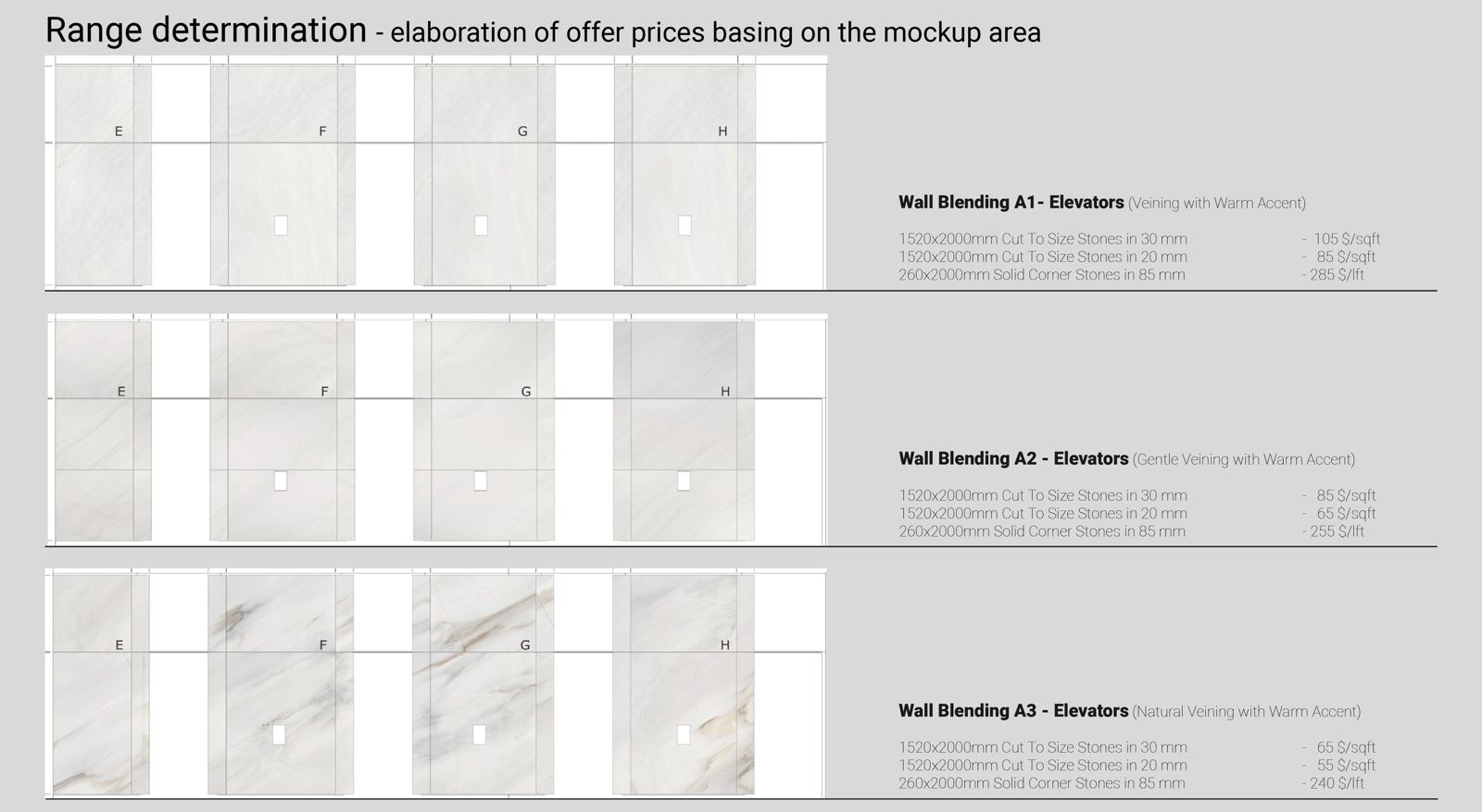
Digital range definition in practice
Three blending variants for the same elevator lobby — from subtle veining to expressive veining. The range decision determines the price per square meter. Beyond veining, the slab layout — meaning how joints are placed — influences both the overall visual result and the cost per square meter.


Planning a Natural Stone Project?
From the specification process to digital layout planning — we show how the workflow works in practice.