The senior knows the stone. The successor knows the digital. The business needs both.
In many stone businesses, the most important knowledge lives in the owner's head. The handover to the next generation is the moment when that knowledge either walks out the door — or becomes the foundation for the digital leap.
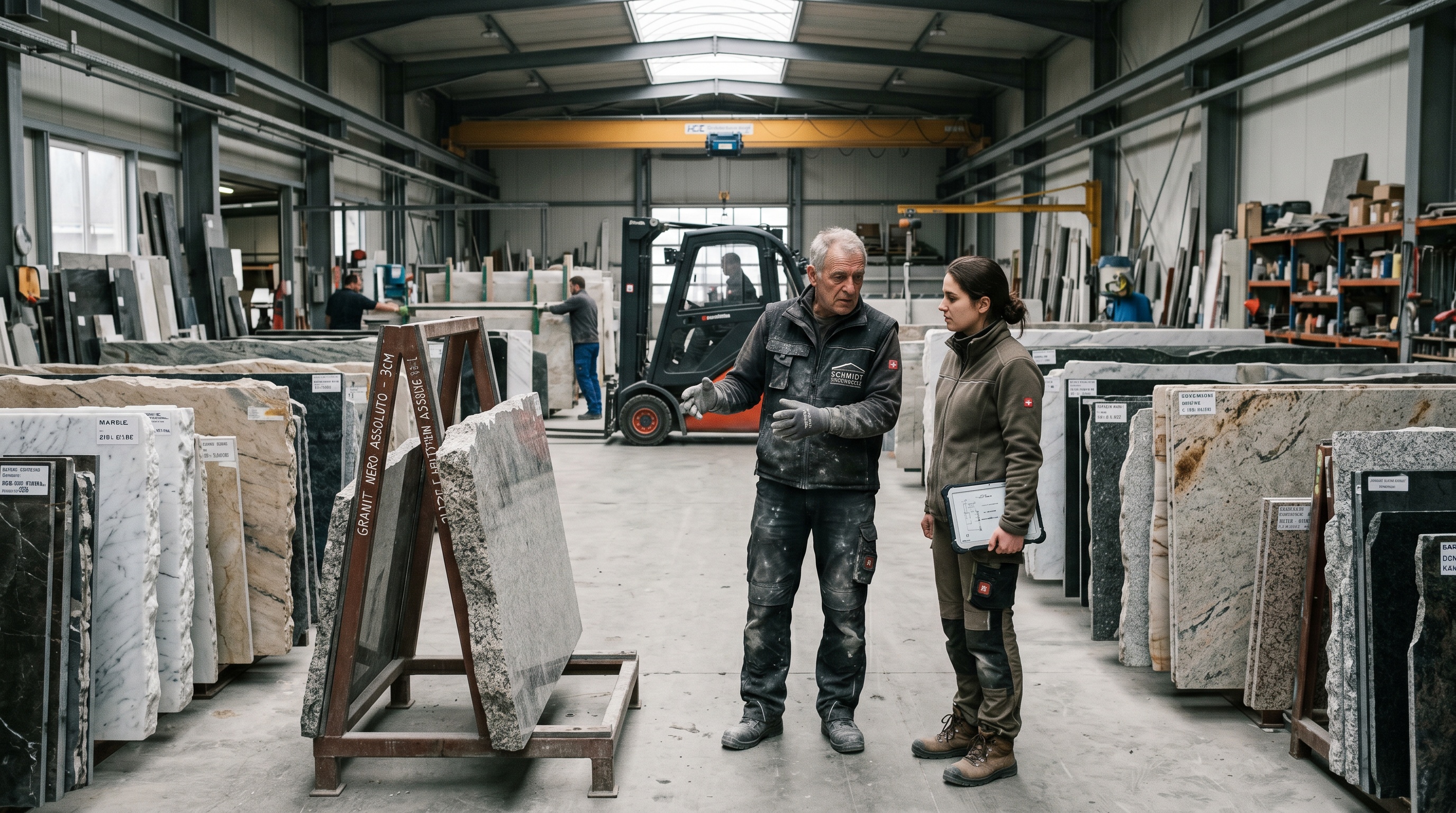
Two generations, one business: the accumulated know-how of the experienced generation and the digital fluency of the young one are not opposites. They are the two halves of a handover done right.
In many stone businesses, the most valuable knowledge sits not in a system but in the head of the senior owner. Which saw blade and which feed rate suit which material. Which milling head gives a clean edge — and which stone frays if you push it too fast. How to work a brittle stone, what helps during installation or bonding. Which supplier is reliable, and where the traps hide in a difficult material. This has grown over decades at the machine and on the job site.
That store of experience cannot be captured or replaced digitally in full. A complete handover is only possible through real projects and the time they take. No software knows how a block feels, or why one particular slab belongs on exactly this wall. That is why the experienced generation is indispensable during the transition — skip it, and you throw away the foundation the business stands on.
The world around the business is changing, and the demands are growing. One example on the horizon: the new EU Construction Products Regulation anchors environmental data in the declaration of performance — a product's carbon figure (its global warming potential, GWP), its recycled content — and provides for a machine-readable digital product passport. For the stone sector there is no obligation to comply yet: the harmonized standards needed for natural stone are still being finalized. The direction is clear — more administrative work. Providers of digital slab-inventory systems are preparing the integration for everyone who manages their stock digitally.
Already today, much of what happens in the business calls for data that can be retrieved and proven, and that line is only getting steeper. It can no longer be handled with tried-and-true methods alone — it takes the next generation, the one that grew up with the digital.
And right now is exactly when many businesses face their handover. In German skilled trades alone, the Confederation of Skilled Crafts (ZDH) estimates that around 125,000 businesses will face succession in the coming years — often without the knowledge ever having been written down anywhere.
The next generation thinks digital
The successor has to take over this business and carry it forward — and brings something the sector has long lacked: they grew up with the digital. They know AI, use it as a matter of course, and they see the opportunity where others still see the risk.
This is not a contradiction to the experienced generation, but the other half of the same task. The young generation knows how to digitalize a workflow. The experienced generation knows what actually needs digitalizing in the first place — and what really counts at the stone. One is worth little without the other.
Both generations are needed
The transition does not succeed when one side replaces the other. It succeeds when both play their part.
The experienced generation brings knowledge and craft: the feel for the material, the tricks of the trade in processing, the customer relationships built up over years. That is precisely the part no AI takes over — the craft stays human.
The young generation brings the digital and the openness: the willingness to rethink workflows, to try out tools and to put to work the data the business produces anyway. AI takes the routine off their hands, not the judgment.
Together that makes a business that keeps its hard-won knowledge and becomes future-ready through fast processes in administration. The willingness is there: in the Bitkom 2025 survey (Germany), 89 percent of craft businesses see digitalization as an opportunity — yet it is rarely put to consistent use. And this is where the real point lies: the best time to digitalize a business is not the period before the planned handover, and not the period after. It is the handover itself.
That has an appeal that goes beyond the technology. The handover is already the moment when responsibility is passed on step by step — and a shared new system gives that transition a frame. It becomes common ground: not the senior's old binders, not the successor's apps alone, but a place where both bring in their knowledge. The senior stays the one who knows the material and the customers; the successor becomes the one who brings the workflows into the present. Both gain standing from it, and that is exactly what creates respect in both directions — and a more open way of working together than when it all ends up back at: that is how we have always done it, so that is how it stays. Set the change up this way, and you hand over not just a business but a way of working, one where the knowledge of one side and the tools of the other come together.
The most common mistake: twenty island solutions
When a business starts to digitalize, the same thing often happens: every problem gets its own piece of software. One for the warehouse, one for quotes, one for time tracking, one for the machine, plus Excel lists and messages on someone's phone. Each one useful enough on its own — but together a patchwork.
That is not just inconvenient, it costs. A block, a slab, skirting or upstands that are already sold in one system still show as available in another. Measurements get entered twice, and maybe with a transposed digit. Anyone looking for a particular slab walks out to the warehouse because they do not trust the various systems — instead of finding it straight away on screen. And when warehouse, production and accounting run in three separate programs with no connection, the same information has to be transferred by hand again and again — every transfer a fresh source of error.
In the end you lose exactly the overview you set out to gain. The data sits in twenty places, no one knows anymore which list is the right one, and the handover to the next generation does not get easier, it gets more complicated.
What a business needs instead is a system that holds the central processes together: one that knows the stock, keeps the right data ready in production, supports the sale where it matters most — with the customer — and passes the commercial figures on cleanly. One place where the information sits, instead of twenty.
How to recognize a system like this
Before it comes down to a specific program, it is worth looking at the requirements. A system that carries a stone business through the handover has to do four things above all. It has to bring the central processes together, rather than stand alongside them. It has to be open — for connecting machines and for digital interfaces, because no business works with a single tool. It has to keep the material tangible: every slab findable again with photo and measurements, every label printable on the spot. And it has to pass the commercial data on to where it belongs — to accounting. Just as important in parallel: the system has to be understood by every employee in the company and be operable in the simplest possible way.
DDL was built for exactly these requirements. DDL stands on a modern technical base and is open to the tools and machines that arrive today and tomorrow. Slabs are recorded with photo and measurements and can be found again at any time, labels print directly, and the commercial figures are handed over to the common accounting programs. DDL doesn't replace your accounting — it feeds it the data. It is a system for the stone business, not another island solution.
And with that, a system like this solves the problem that hangs over every handover. Most of what keeps a well-run business going is written down nowhere — it sits in the senior's head. Which customer forgives a delay and which does not. Which block, despite a fine fissure, still yields the right slab. How to price a tricky job without misjudging it. This experiential knowledge can barely be written down — and that is exactly why it walks out the door with the senior if it has found no place by the time of the handover. The successor then inherits a business, but not the memory behind it.
A shared system turns that around. It makes the experiential knowledge into something tangible, piece by piece — the recorded slab with photo and measurements, the stored customer history, the traceable calculation. The senior does not give up their knowledge, they give it a place. The young generation builds on it instead of starting from zero. That is how the change turns from a risk into an opportunity — and the system into the bridge where both generations meet.
The right moment is now
A business is not handed over every day. The generational handover is the one moment when everything comes onto the table anyway: workflows, knowledge, responsibility. Use it to bring in one system instead of twenty island solutions, and you do more than pass the business on — you make it future-ready at the same time.
The experienced generation does not have to give up its knowledge to do that. It gives it a place. And the young generation does not have to start from zero, but builds on what has grown over decades. This is exactly where we want to help with DDL. Let's talk about what the transition could look like in your business.