Natural Stone Installation Without Limits — Why the First Cut Happens on Screen
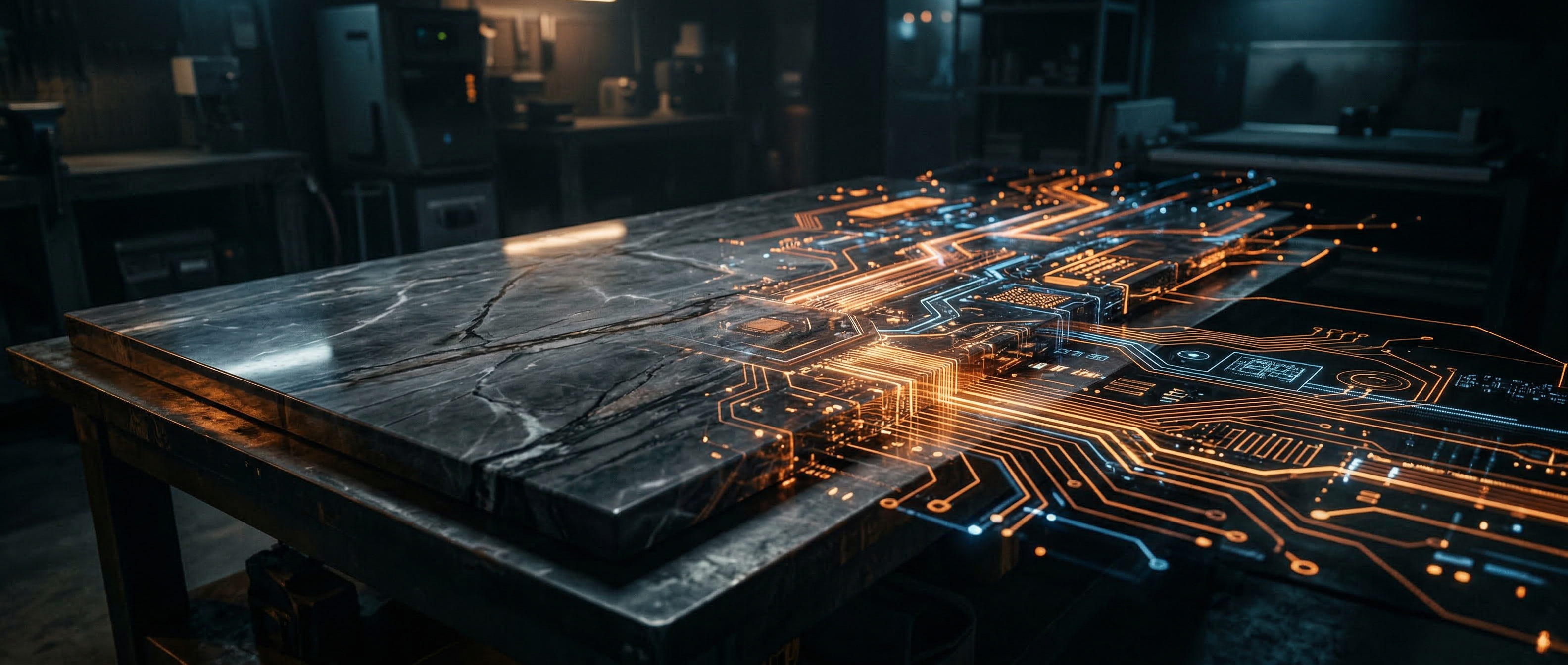
One slab after another — positioned digitally before a single cut is made. Every vein run placed with intention. Why physical dry-lay is hitting its limits, and how digital planning is changing the workflow for architects, stone consultants, fabricators and installers.

What Physical Dry-Lay Actually Costs
Every natural stone slab is unique. Slabs from the same block can differ so markedly in veining and colour depth that placed side by side they either create a harmonious composition or actively work against each other. That is precisely why physical dry-lay has been the industry standard for decades — slab by slab, vein runs checked, reordered, photographed, and sent to the architect for sign-off.
The problem is not the method itself, but the effort involved. A project covering just 120 square metres can generate an enormous amount of time spent on dry-lay alone. Add to that the logistics: natural stone slabs weigh between 30 and 80 kilograms per square metre. Every time a slab is repositioned, there is a risk of chipping edges or breaking corners — damage that can render a slab completely unusable for the project. If the architect is not on site, a digitally transmitted photo becomes the only basis for a decision — with no scale, no context, and no ability to rearrange anything.
On international projects, that effort becomes a full stop. When the architect is in New York, fabrication happens in Italy, and installation is planned for Atlanta — physical dry-lay fails on geography alone. In the past, teams tried to lock in the desired range using sample slabs. But small samples cannot convey the overall impression of a large surface. Using full-size raw slabs to communicate the range is possible only in limited quantities — far too few to represent the character of a 400-square-metre facade.
Yield is the single greatest economic risk for stone producers. It must be calculated accurately before the project begins to produce a sound estimate. When that fails, the producer takes on a risk that either shows up in the financials or, ultimately, in the quality of the stone delivered. Knowing what will be cut before the first cut is made is how the costliest mistake gets avoided: destroying a slab that cannot be replaced.
Three Perspectives — Who Benefits and How
Architects: Real Slabs, Not Catalogue Images
An open offer for a Calacatta surface is worthless if the architect does not know which slabs will actually be supplied. Digital planning displays real slab photos to scale on screen — with veining, surface finish and dimensions visible. Vein continuity can be assessed across multiple slabs, and material utilisation is shown live. A visit to the warehouse becomes an option, not a requirement.
Fabricators: Machine-Ready Cutting Data
What gets planned on screen must reach the machine accurately. Digital planning systems export cutting data in machine-readable formats — the hand sketch is replaced by a precise digital specification. Cutting tickets are now recognised and extracted automatically from architectural files. The error source of "interpreting a paper drawing" is eliminated entirely.
Dealers: Making Stock Visible
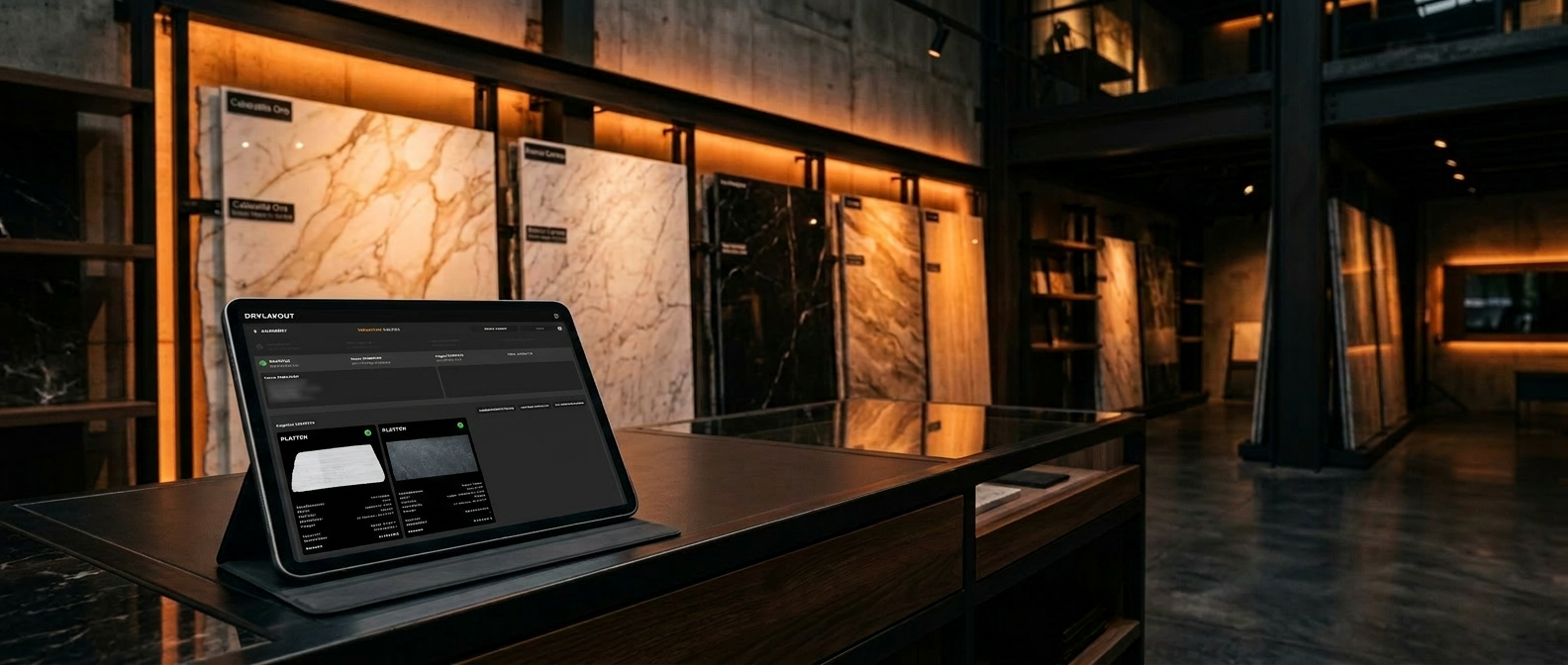
Anyone selling stone slabs needs to be able to show them in detail. Digital systems make inventory available online with real photos — each slab individually, with its source block and surface details. Clients make informed decisions without an in-person selection visit, and returns due to mismatched expectations decrease. Sales teams work with facts instead of promises.
Yield Is Everything — Why Digital Planning Reduces Waste
Avoiding waste in expensively sourced slabs is the paramount concern for every stone producer. In a traditional project workflow, the architect defines a range — the acceptable band of veining and colour tone. This early decision routinely excludes areas of the slab that occur naturally and frequently. The result: the proportion of waste within a project rises considerably.
Digital layout planning opens a different path. With real slab photos on screen, it becomes possible to work with areas the architect might initially dismiss. Through digital dry-lay, the overall harmony of the stone composition can be made visible. Often, the result is a more natural and more striking finished surface. Waste within the project drops substantially. Production costs for the fabricator fall, and a more competitive price for the overall project becomes achievable. The flip side is equally significant: the stone the architect originally specified stays in the project, rather than being substituted for a cheaper alternative to make the numbers work.
Lasa Marmo, an international natural stone producer from South Tyrol, has been working with digital layout planning for five years. The entire production workflow — from slab selection through cutting planning to CNC export — runs digitally. The result: approximately 20 percent cost savings across planning, material and production. Today, no project starts there without digital planning. Lasa Marmo projects typically involve architects, producers and installers across different countries and sometimes different continents — working from an identical data set, the same slab photos, the same plan.
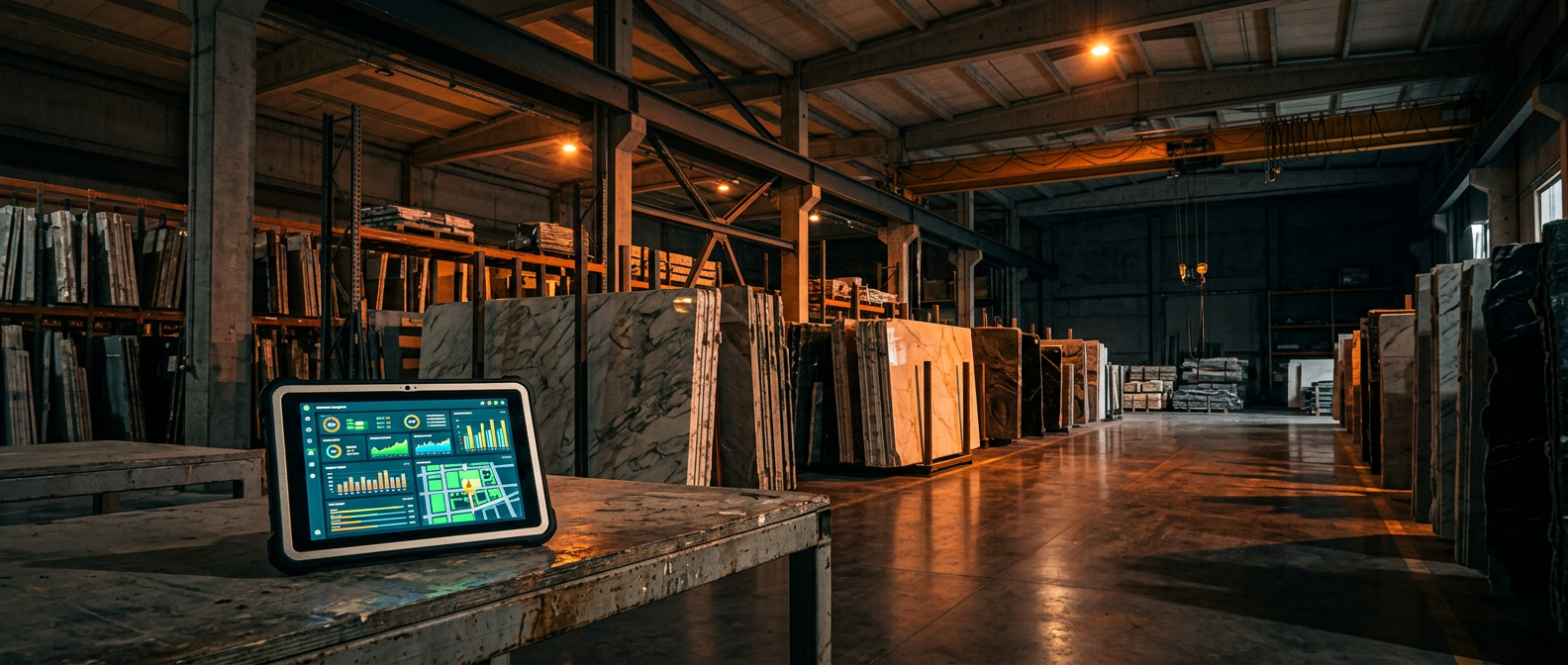
A candid note: digital planning does not replace physical dry-lay in every case. A single kitchen countertop does not require digital layout planning. The method pays off on projects with complex geometries, facades requiring vein continuity, and international collaborations — wherever a mistake costs three days rather than three minutes. And starting out demands discipline: every slab needs to be photographed and logged once. Digital capture can be rolled out incrementally, in step with what production schedules allow. Once captured, each slab is identified by a barcode — making it immediately clear at a glance what has already been digitised and what still needs to be done.
For the digitisation process, operations typically target periods when staff have free production cycles. These are used systematically for slab capture until the entire inventory has been digitised.
Digital Project Planning — From Slab Photos to Cutting Plan
Example: An architect is planning the lobby of a hotel using 800 square metres of Statuario. Real slab photos from the warehouse are displayed, positioned to the millimetre on the floor plan, and vein transitions are checked across the full surface. Material utilisation is calculated live. On approval, the system generates CNC-compatible cutting data — the producer cuts exactly what was planned. DDL covers this entire workflow from slab digitisation through to cutting plan.
Explore Project PlanningThree Steps to Digital Layout
Digitise the Slabs
Each slab is photographed and recorded with its dimensions, surface finish and source block. Starting with a smartphone is enough to begin digitising slabs and planning precise cuts. A fixed scanner or photobooth is the professional-grade solution. Either way, the result is a true-to-scale digital representation of every slab.
Plan to the Millimetre on Screen
Architects or planners position real slab photos to the millimetre on the project surface — based on the current architectural files. Vein runs are checked, colour transitions refined, yield calculated. DXF floor plans can be imported so planning is based on the original construction drawings rather than estimates.
Export the Cutting Data
What has been planned is exported as a CNC-compatible file — including cut lines, quantities and material assignments. The producer cuts exactly to plan, with no interpretation required. This eliminates one of the most common sources of error: misreading the project range as defined from large slab samples.
The Cut Comes Last
Digital layout planning does not make natural stone any less of a craft. It makes the process that precedes it more precise — so the craftsperson at the end knows exactly what needs to be done. Physical dry-lay does not disappear; it moves from the workshop floor to the screen. And there it runs faster, from any location, without the risk of chipping a slab during repositioning.
Anyone who has relied on physical dry-lay to date invests considerable effort every time in optimising veining for architect sign-off. Digital planning shows the result before a single slab is moved.
The stone industry is one of the last to take this step. While CNC machines are now standard in most operations, digital planning upstream is still frequently missing — the link between material selection and machine programme. Industry observers such as Stone World Magazine have documented for years that this is precisely where the greatest efficiency gap lies. The technology meanwhile shows what is possible: 5-axis milling and waterjet cutting now achieve tolerances of 0.4 millimetres — but only when the cutting data arriving at the machine is correct.
Further reading: Natural Stone Inventory Management, Software for Stone Fabricators and Digital Customer Service.
Explore DDL Solutions
Natural Stone Digital Planning — See It Live
Jan Keller demonstrates in 30 minutes how digital layout planning works — from slab digitisation to CNC export. Hands-on, with real project data.