Natural Stone Waste: Are Your Offcuts Collecting Dust or Generating Revenue?
Every natural stone project produces offcuts during cutting. These can range from smaller slabs around 30×30 to half a valuable full slab. Every stone business faces the same question: do these remnants become dust collectors in the warehouse — or is there real revenue potential in them? Digital tools offer a smart solution: remnants are listed in the stone gallery immediately after production, with all dimensions, photos and material properties, ready for every sales channel.

Verschnitt: analog auf Palette versus digital in einer Galerie
The hidden cost of waste in natural stone businesses
Waste is unavoidable when processing natural stone. Every slab is unique with its own dimensions. Projects demand specific formats. Research into industry data shows: iCounterSoft and the IJTEE Journal put average waste at 15 to 25 percent of incoming material. Park Industries reports figures above 40 percent for businesses without digital planning.
With a material budget of €500,000 per year and 20 percent waste, that means €100,000 purchased, transported, stored and then disposed of — not as a defect, not as a warranty claim, but as a process loss.
Natural stone adds a dimension other industries do not face: waste is also an aesthetic decision. Projects specify a visual look, certain colour gradients are excluded — and the stone business must cut slabs from a block so that they fall within the approved Range. The excluded sections are not defective. They simply do not match the project visual.
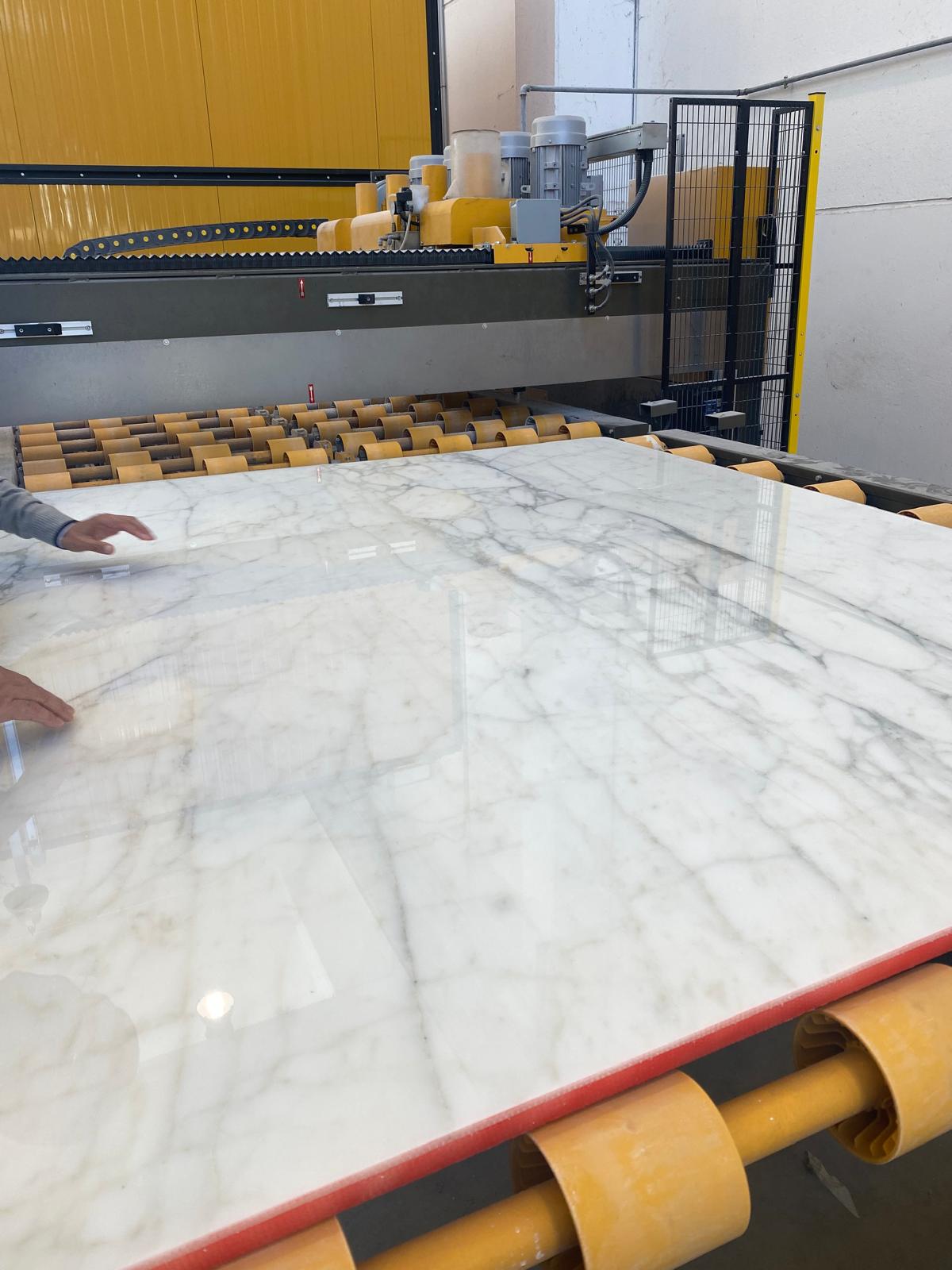
Der Range entscheidet, was von dieser Platte für ein Projekt Verwendung findet und was als Verschnitt übrig bleibt.
Three paths to optimisation
Planning before the cut
The greatest optimisation step happens before the cut. Digital Dry-Layout — the virtual arrangement of cut pieces on the slab before the physical cut — shows which combination produces the least remaining area. For projects with Range requirements, it also addresses colour harmony: arranging slabs so that the Veining remains consistent across joints. Jan Keller describes the cause-and-effect chain: when architects exclude fewer sections because the overall look in the Dry-Layout is convincing, waste decreases and the fabricator can offer a better price. Digital Dry-Layouts allow projects to be visualised in their entirety or in overlapping sections with minimal effort — followed by optimised production preparation, so cut data per slab package is available digitally and the production workflow becomes significantly more efficient.
Systematic offcut capture
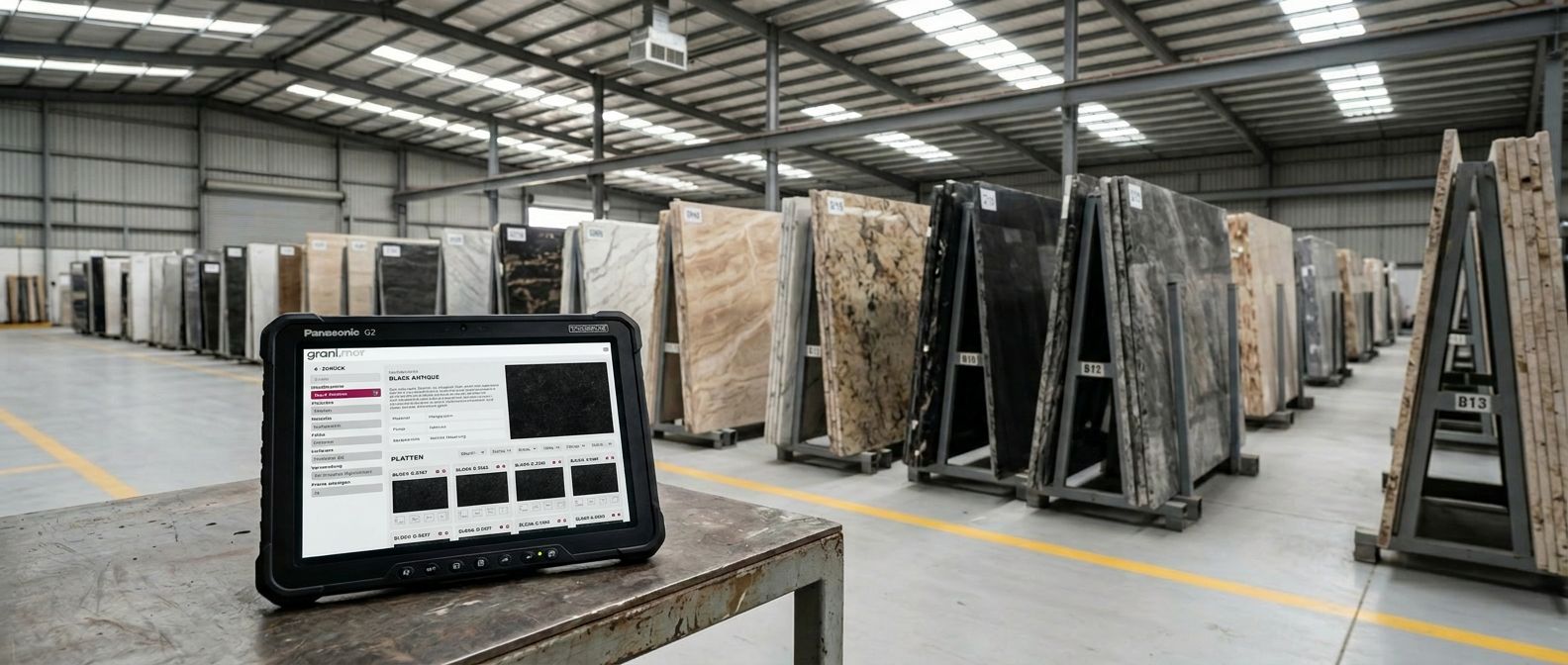
In many businesses, offcuts sit on A-frames in a corner of the workshop. The foreman knows what is there — as long as he is still with the company. Finding a usable piece means the team has to walk to the A-frames, inspect together, pull individual slabs and measure them. A time-consuming process that rarely justifies the revenue from selling the remnant. For sales and the team, these remnants are effectively invisible. Every offcut that is not logged with a photo, dimensions and material data does not exist for the sales team. It ties up capital, takes up floor space and is eventually disposed of — even though it could fully cover the material requirement for smaller projects.
Actively selling offcuts
According to Stone Empire Fabrication, offcuts sell with a 30 to 70 percent discount against full slabs. That sounds like a loss — but it is revenue from material that would otherwise be disposed of. An example: a Calacatta offcut measuring 80 × 120 cm is enough for a vanity top. As a full slab the material costs €400 per square metre — the offcut as a special item still brings €150–200 instead of zero. Businesses that make their offcuts visible in a digital gallery reach customers with exactly that need.
The waste cycle in the business
Material is lost at several points. The obvious waste happens during cutting — the difference between slab format and project format. Less obvious: material that falls outside the approved Range due to architect restrictions. Or slabs reserved for a project that no longer fit after a design change and sit unnoticed in the warehouse.
Brian Hassig, a stone fabricator in the luxury segment, puts his current waste at 25 percent. That is not an unusual figure for businesses handling high-value projects with strict aesthetic requirements. Material costs per project are particularly high — and so is the absolute loss from waste. Here the solution lies in clever order combination — pairing luxury projects with smaller ones — cutting remnants immediately to usable sizes and deploying them for additional projects.
Lasa Marmo, a DDL customer in South Tyrol, increased material yield by 15 percent. Patrick Pritzi, who uses the planning tool daily, confirms cost savings of around 20 percent through better material management and Veining matching. The difference is in the process: cut planning happens before the saw, on screen, with all slabs from a block in view — and with the Veining flow as the decision basis.
About DDL: Offcuts as individual objects
DDL records every slab offcut as an individual object on active input — with photo, dimensions, material data and status (included in quotes, reserved, sold). Offcuts appear in warehouse management alongside full slabs and can be made visible to customers and directly quoted via the fast quote creation tool. Before every cut, the planning tool shows whether a matching offcut is already in stock — before a new slab is opened.
Learn moreReducing waste costs — three concrete steps
Take stock
Record all offcuts systematically once: material type, dimensions, thickness, photo. This is a one-off effort — after that, every new offcut is automatically listed in inventory. Businesses that take this step regularly discover usable material sitting in the warehouse that the sales team knew nothing about.
Check before every cut
Before opening a new slab: is there an offcut in stock that fits the order? That saves a slab — or at least part of one. Digital Dry-Layout makes it possible to combine multiple projects so that different slab formats sit clearly in one project and slabs are used more efficiently. iCounterSoft documents a case where job batching — five orders on two slabs instead of individually — reduced material costs by 33 percent.
Review monthly
Measure waste rate per month: incoming material minus sold area minus recovered offcuts = loss. The number alone does not change anything — but it makes the problem visible. Digital platforms like DDL allow daily analysis with clear charts — not just a daily overview but a month-by-month comparison. With the team, targets can be set that lead to tangible savings in material consumption and higher yield. Businesses that reduce their waste rate from 20 to 15 percent save €25,000 per year on a €500,000 material budget.
Less waste, more yield — the lever is in the planning
Between the industry-standard waste of 15 to 25 percent and the 40 percent of a business without planning, there is significant room to manoeuvre. Lasa Marmo shows that 15 percent more material yield is achievable — with digital Dry-Layout, systematic offcut capture and a cutting workflow that brings Veining and geometry together.
The first step: check whether the existing software provides this level of transparency — or whether new tools are needed. Then walk through the warehouse, record offcuts systematically and make them accessible to the sales team.
Questions about waste optimisation or offcut management: Jan Keller is happy to help.
On the topic: Excel spreadsheets versus digital slab inventory.
Explore DDL Solutions
Improve material yield?
Jan Keller shows how stone businesses measure their waste, systematically capture offcuts and improve material yield.