Digital Customer Service in the Natural Stone Industry: Why Slab Photos Sell More Than Samples
Natural stone is not a mass-produced product — material selection is always an individual visual decision. A US stone supplier achieved 40 percent better customer satisfaction within three months of implementing a digital inventory system. Five examples from the industry show what makes the difference.
Why Customer Service in Natural Stone Is a Unique-Product Problem
Selling tiles means sending a sample. Selling laminate means showing a catalog. Neither works for natural stone — every slab has its own veining, its own inclusions, its own color gradient. An architect planning a specific vein pattern across a lobby wall needs to see the actual slabs. Not a product photo, but the exact slabs that will be installed. This makes customer service in the natural stone industry fundamentally different from any other building materials sector.
On top of that, there is a problem that simply does not exist with mass-produced goods: double-selling. When two customers have the same Calacatta slab in their quote and both accept, one of them has a problem — and the fabricator has a damaged customer relationship. The cause is almost always the same: a lack of real-time transparency over slab inventory. Manual management leads to lost oversight as soon as multiple quotes are open simultaneously. Lasa Marmo, a South Tyrolean marble producer, uses DDL to digitize inventory, quotes, and projects — and additionally benefits from digital project planning: 15 percent higher material yield and 20 percent lower costs. When every slab is digitally positioned and matched to design specifications before cutting, less waste is produced. And double-selling is prevented as a side effect, because slab inventory is visible in real time.
Three Levers That Make the Difference in Natural Stone
Slab Photography Instead of Samples
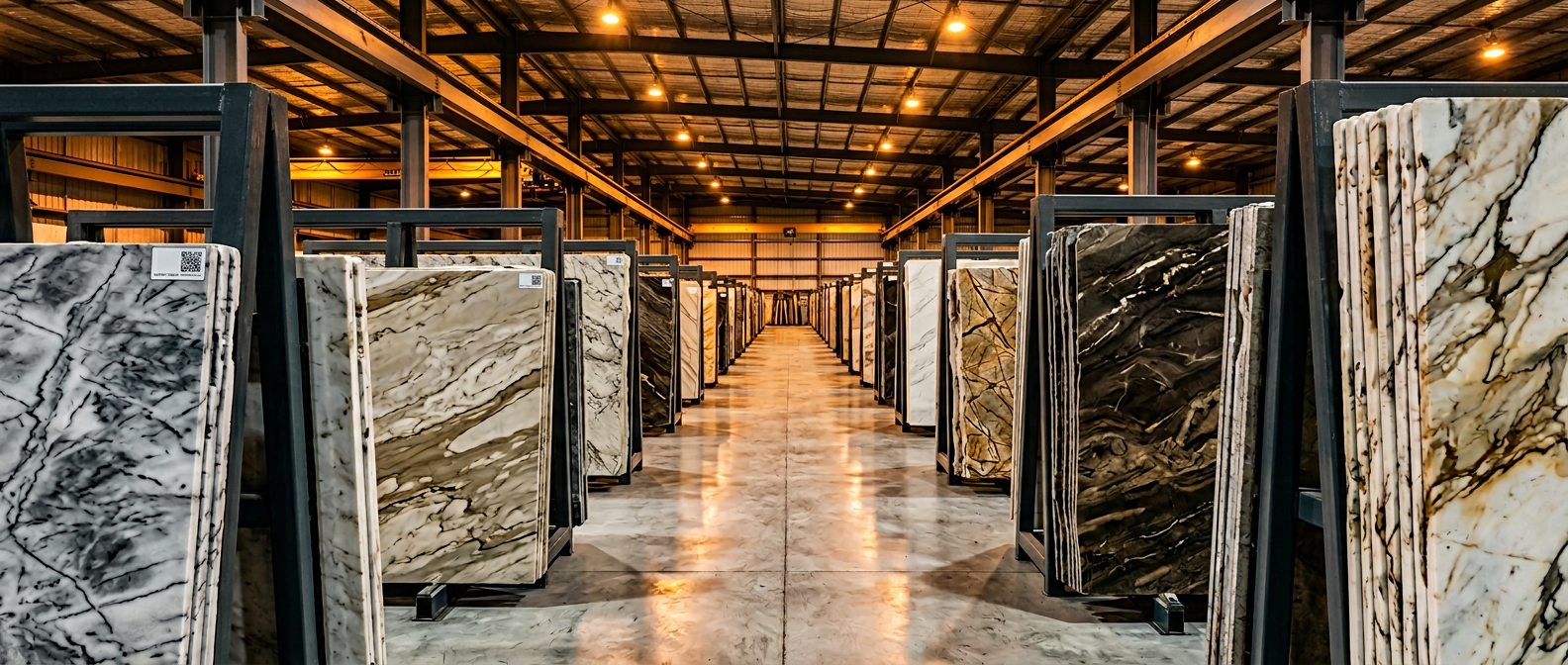
Systems like Pathfinder and SlabSmith capture every individual slab in calibrated high-resolution photos — with veining, surface finish, source block, and dimensions as metadata. At Lido Stone Works in New York, staff show slab photos on tablets directly at the customer's location. Material selection shifts from the warehouse to the screen. For international projects, this is often the only practical approach.
Slab-Referenced Quotes Instead of Price per Square Meter
A quote for "20 m² of Carrara marble" is useless for high-end projects — the customer wants to know which slabs. Digital quoting systems reference specific inventory positions with photos. Upon acceptance, the slabs are automatically reserved, and double-selling is prevented at the system level. And when the architect accepts only 15 out of 20 slabs — more the rule than the exception in natural stone projects — the rest is automatically released.
Audit Trail from Block to Delivery
Every status change of a slab is documented: Available, Reserved, In Production, Shipped, Delivered. Customers with portal access can track progress themselves, without calling. The error rate drops measurably: barcode-based systems reduce inventory errors from 1 to 4 percent (manual entry) to below 0.1 percent. For high-value unique products, this is not a convenience feature — it is business-critical.
What Stone Fabricators Have Actually Changed
At Natural Stone Design in Sacramento, investing in CNC technology tripled their volume — from 3 to 40 employees, now processing 20 to 25 kitchens per week. The machines alone would not have sustained it: every customer gets a dedicated project manager as a single point of contact, and the unified digital workflow from templating to installation holds operations together at this volume.
A fabricator in Chicago achieved 28 percent less material waste through digital photo-based inventory and uncovered over 85,000 US dollars in previously overlooked remnant slabs — remnants that were invisible in the analog system. At a dealer with three locations in Austin, excess inventory dropped by 35 percent and turnover rose from 3.2 to 5.1 within six months.
Brekhus Tile & Stone in Denver reports that digital laser templating measurably reduces material requirements: jobs that previously needed two full slabs fit on one through more precise nesting. At Lido Stone Works, customers receive digital CAD files with the planned slab layout — available for download and editing. The vein matching that once required a warehouse visit now happens on screen.
Slab-Level Quotes — with Automatic Reservation
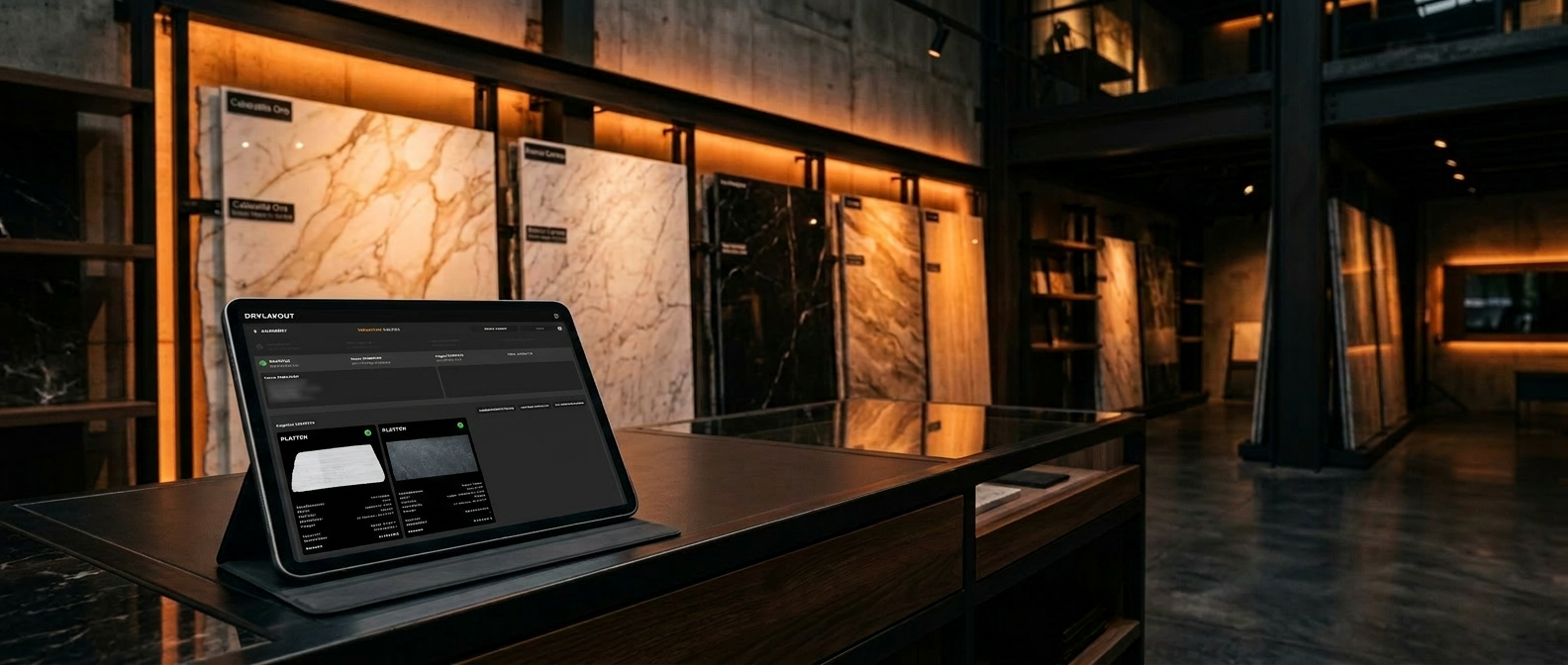
DryLayout connects inventory management and quoting at the level of individual slabs. Every slab is recorded as a unique item — with photo, veining, and surface finish. Quotes reference specific inventory items, customers confirm via portal link, and reservation happens automatically. Partial acceptances are built in. Eight defined order phases document the journey from design to delivery. Integrated project planning enables managing material allocation, phases, and budget per project — from the design phase through fabrication to installation.
Discover the workflowThree Steps to Make the Switch
Measure loss points
Where are orders being lost? For most stone fabricators, not on price but on speed. The quote arrived two days too late, the desired slab was already reserved, the architect got material photos faster from a competitor. An honest analysis of the last ten lost orders reveals the biggest lever.
Link slab photos and quotes
A CRM without slab photos is of little value in natural stone — if the system does not show what the available slabs look like, it cannot create reliable quotes. The key is the direct connection: photo, dimensions, price, and availability flow into the quote without manual lookups. Standalone solutions without this connection only create new data silos.
Plan for 30 to 45 days
Industry experience shows: switching to a digital inventory system typically takes 30 to 45 days until full adoption. This is not an IT migration — it is a process change. The biggest hurdle is not the systems but the habits: someone who has managed slabs from memory for 20 years needs good reasons to make the switch.
Selling Slabs Means Showing Slabs
The global natural stone market is growing from 37.89 billion US dollars (2025) to an estimated 49.66 billion by 2031. Most documented cases of digital customer service transformations come from the US — in Europe, operations like Lasa Marmo are the exception, not the rule. That is changing: the European market is catching up, and implementation barriers are lower than five years ago. Stone fabricators who establish slab photos, automatic reservation, and customer portals as standard practice do not just work more efficiently — they get recommended.
The technology is proven and implementation is manageable. What remains is the decision. Further reading: AI in the natural stone industry and Software overview for stone fabricators.
Explore DDL Solutions

Ready for digital customer service?
Jan Keller shows how natural stone businesses combine slab photography, quoting, and project tracking in one system — hands-on and with no obligation.