Warehouse Management in Stone: 8 Problems That Cost Money
The slab warehouse — loved and hated in equal measure. Loved because it holds hundreds of slabs, beautiful materials, customer promises, the foundation of every project. Hated because of all the tied-up capital, the lack of overview, and the slab that got damaged again during repositioning. Some problems are universal: ghost stock, double sales, forgotten offcuts, endless searching. Everyone knows the real issue is rarely the material — it's almost always the system behind it. And every single problem costs time, which means money.
- Ghost Stock — Slabs That Only Exist on Paper
- Search Times — When Staff Comb Through the Warehouse
- Double Sales — One Slab, Two Promises
- Forgotten Offcuts — Tied-Up Capital With No Revenue
- No Overview From the Office — Walking to the Warehouse for Every Question
- Communication Errors — When Post-Its Are the System
- Excel Doesn't Scale — When the Spreadsheet Becomes the Bottleneck
- Five Programs Instead of One — When Nothing Fits Together
- Eight Problems, One Root Cause — and a Starting Point That Costs Nothing
Ghost Stock — Slabs That Only Exist on Paper
The system shows 40 slabs of Nero Assoluto. In the warehouse there are only 34. The difference: two were quickly used for a small job last week but never booked out. Two were placed on a pallet for an order that nobody can find anymore. And two were wrong from the start — only 38 were delivered.
Ghost stock appears wherever the physical and digital state of the warehouse drift apart. When recording doesn't happen at the point of action — but later, in the office, from memory — errors are inevitable.
Asking the team for more discipline usually fails against the reality of daily operations. The right approach: every slab movement is recorded where it happens. Scan a barcode on receipt, on relocation, at cutting, on delivery, when offcuts are returned. Once a quick scan becomes standard for every step, ghost stock disappears.
Search Times — When Staff Comb Through the Warehouse
A request comes in. There's a vague memory: "We have that stone somewhere." Somewhere?! So it's out to the warehouse, rack by rack, find it, move slabs, worst case pull slabs out to check for defects in the bottom-left corner, quickly photograph them while there — just to be safe — then back to the office to write the quote.
Ten minutes sounds like nothing. But when that happens every day, it adds up to over 40 hours a year — a full working week. Everyone can calculate what a week's labour is worth. In a business where five people regularly search for the right material, that's an entire month of lost working time.
The alternative: capture inventory digitally and use a search function instead of a search party. Enter material, thickness, finish — the stock instantly shows what's available, where it is, and what it looks like. The slab no longer needs to be found. It has an address and can be located and retrieved on demand.
Double Sales — One Slab, Two Promises
During a sales call, salesperson A reserves three slabs of Patagonia Green for a kitchen project. The following day, a colleague plans the same slabs for a different customer's bathroom — unaware they've already been promised. Both quotes go out. One customer will be disappointed.
Double sales don't happen through carelessness. They happen because reservations and planning run in separate systems — worst case, in no system at all. A quote sent on paper changes nothing about the warehouse status of those slabs. A quote in a connected system automatically reserves the slab and makes it visible to everyone in the business as already committed.
This isn't a nice-to-have. For a business working with unique pieces — and almost every natural stone slab is unique — real-time reservation is an economic necessity.
Forgotten Offcuts — Tied-Up Capital With No Revenue
Every cut produces not just small waste pieces but larger offcuts too. A piece of Emperador Dark at 120 × 30 cm — enough for a windowsill. A slim offcut from a resin-treated travertine slab — enough for a small vanity top. In many businesses these pieces end up on a pallet, pushed into a corner, and left to gather dust.
The problem isn't the offcut itself. The problem is that it becomes invisible. No catalogue, no photo, no system knows it exists. The next customer who urgently needs exactly those dimensions is told: "We don't have that." Even though it's right there.
When offcuts are properly captured straight after cutting — photo, dimensions, new barcode — they become sellable. The pallet in the corner becomes active stock. Read more: Optimizing Cutting Waste in Natural Stone Operations.
No Overview From the Office — Walking to the Warehouse for Every Question
A customer calls: "Do you still have anything in Jura Yellow, polished, 3 cm?" The honest answer would be: "I'd have to check." Checking means: stand up, walk to the warehouse, search through racks, come back, call the customer back. If they're even still reachable by then.
Stone fabricators who manage their stock digitally answer that question on the phone. Apply filters, see results, show a photo or send it directly to the customer via WhatsApp. In the time it takes a staff member in an analogue business to put on a jacket, a digital business has already sent the quote.
Speed isn't a convenience — it's a competitive advantage. The business that sends a firm quote with real slab photos first, and can solve the customer's problem, wins the job. The rest lets material gather dust.
Communication Errors — When Post-Its Are the System
A note on a folder: "3 slabs reserved for Müller project." If the note falls off, the reservation is gone. If the folder changes hands, the context is lost. If a change is discussed on the phone, only one person knows about it the next day.
Communication errors are the most expensive type of mistake in a craft business. Every verbal agreement that never makes it into the system is a potential misunderstanding — and every misunderstanding costs money, material, or customer trust.
The way out isn't a better note-taking system. The way out is a system where every status change — reserved, in production, delivered — automatically becomes visible to everyone. When that status is linked to the slab itself, visible on every subsequent lookup, there's no ambiguity. The post-its can go back to being used for the things that actually matter — like a thank-you note for the production team.
Excel Doesn't Scale — When the Spreadsheet Becomes the Bottleneck
Excel works. At the start. A spreadsheet with material name, thickness, dimensions, maybe a location. Until the business grows, the warehouse swells to 500 slabs, and three staff want to look at the same file at the same time.
The problem isn't the spreadsheet itself — it's the missing connections. Excel knows nothing about the quote that just went out. Nothing about the slab being cut right now. Nothing about the customer who wants to see photos online. Every one of those connections has to be made manually — by phone, by email, by shouting across the workshop. That's the break in the chain.
For the full comparison: Natural Stone Inventory in Excel vs. a Digital Slab System.
Five Programs Instead of One — When Nothing Fits Together
Inventory list in Excel. Quotes in the email client. Photos on a mobile phone and on the owner's computer. Customer data in Outlook. Production status on a whiteboard at the back of the workshop. Five systems, no data exchange, five places where errors can occur.
Each system in isolation is a place where information gets lost to colleagues. The slab listed as "available" in Excel has already been promised to a customer in an email quote. The photo the customer wants to see can't be found on the phone but is sitting on a computer that's not currently reachable.
What stone fabricators need isn't a sixth program. It's a system that connects warehouse, quoting, customer communication, and production — not because it's technically elegant, but because it eliminates the error sources that arise between disconnected programs.
Warehouse, Quotes and Projects in One System
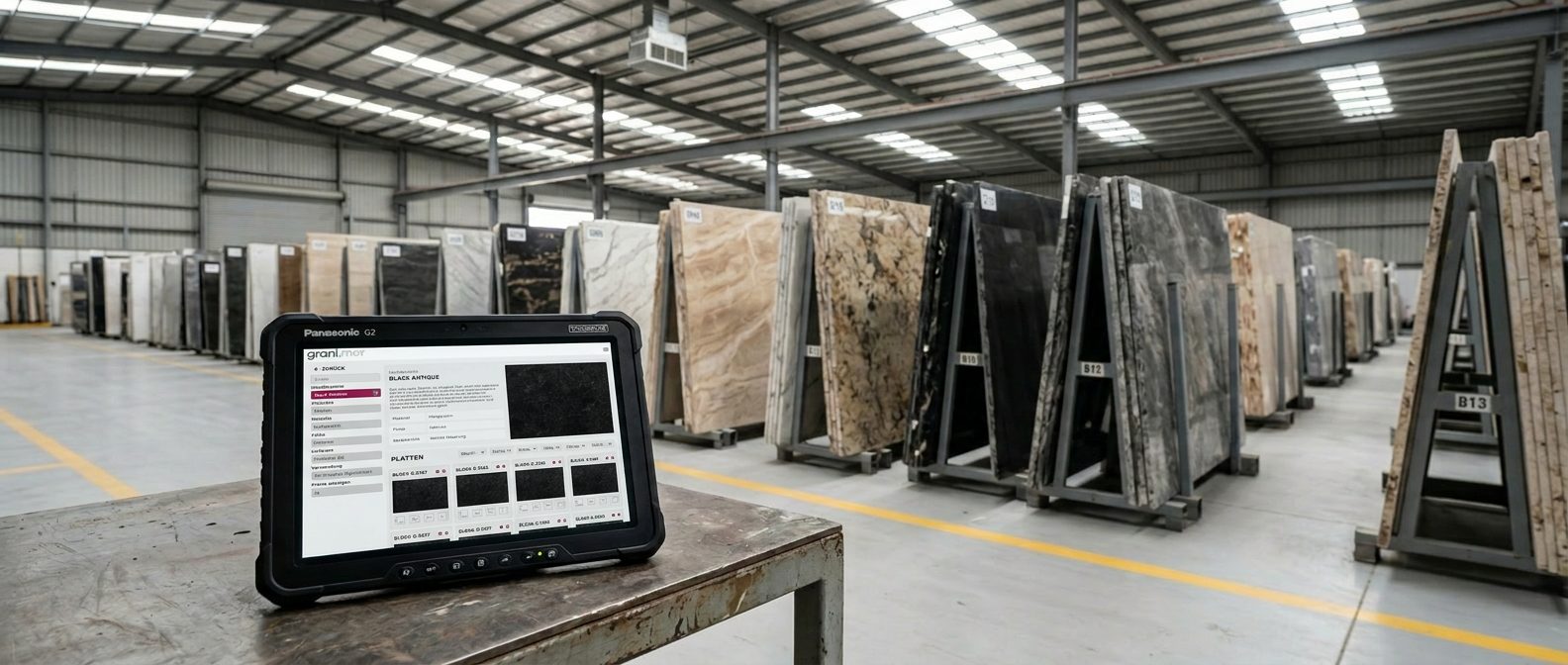
DDL connects warehouse management, quote creation, customer portal, and project planning. Each slab is captured once — photo, dimensions, barcode — and is then available across every process: from checking stock on a call, to sending quotes with real slab photos, to reserving and cutting. One system, no broken handoffs.
Explore Warehouse ManagementEight Problems, One Root Cause — and a Starting Point That Costs Nothing
The eight problems share a single root cause: information about the slab isn't where the decision is being made. Not at the desk when the quote is being written. Not on the phone when the customer asks. Not in the warehouse when a staff member is searching.
The solution doesn't start with a six-figure software investment. It starts with the first barcode on the first slab. And grows from there — piece by piece, slab by slab — into a stock that's visible from the office, searchable, and up to date in real time.
What that looks like in practice — from smartphone to stone gallery: Digitalising Natural Stone Slabs — From Photo to Stone Gallery.
Questions about warehouse management are answered by Jan Keller.
Explore DDL Solutions
Get Slab Inventory Under Control?
Jan Keller shows how DDL connects warehouse management, quotes, and project planning in one system — from the first barcode to the finished project. One conversation, 20 minutes.