Digital Templating — Analog Stone Slab Inventory?
Few stone fabricators today still question the value of digital templating. 14,000 to 40,000 euros for a Proliner, a Flexijet, or an LT-2D3D — the investment pays off, that is the consensus. But why does the same decision feel so much harder when it comes to internal operations? Digitizing the slab inventory, maintaining consistent project tracking, managing remnants online — all of this costs a fraction of the scanner. And yet shops hesitate for years. This article asks why external precision has become second nature — while internal transparency has not.
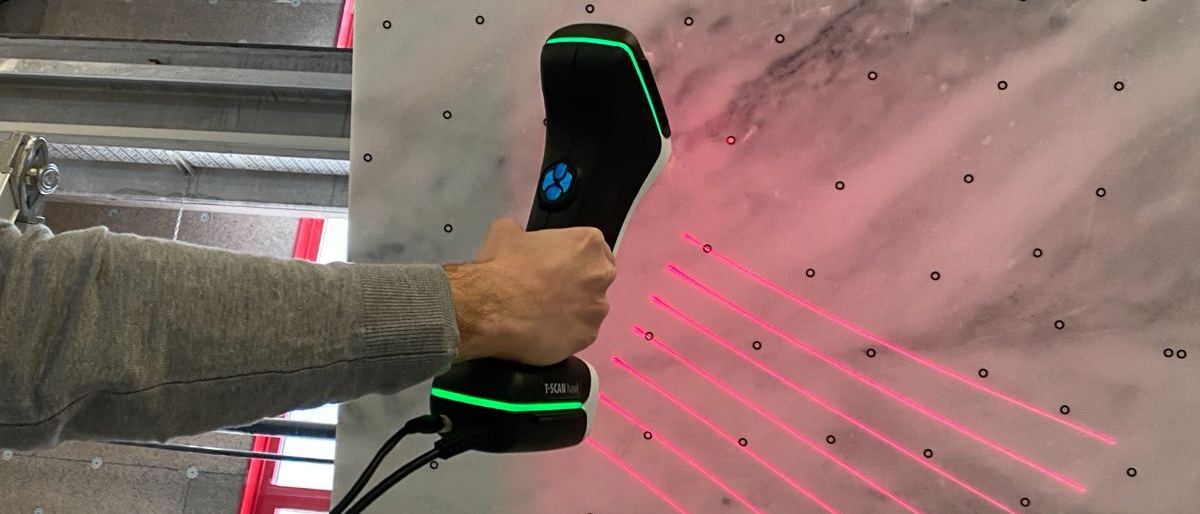
On the Job Site, Every Millimeter Counts
Digital templating is one of those investments that nearly every stone fabricator either already has or has on the roadmap. A Proliner from Prodim, a Flexijet 3D, an LT-2D3D from Laser Products — these systems run between 14,000 and 40,000 euros (Source: Stonegate Tooling, Laser Products, Prodim). Training, laptop, and service contract add to that. One costly mistake on-site and the decision is made quickly. Sometimes within a few hours.
Why? Because the benefit is tangible. Fifty to seventy percent less time per template compared to stick templating (Source: Laser Products, Prodim). Instead of one to two hours per room — whether it is a kitchen countertop, bathroom floor, staircase, or wall cladding — the survey takes 30 to 45 minutes. The DXF file is emailed back to the shop before the equipment is even loaded in the car.
Thirty-five percent of stone fabricators now work exclusively with digital templating, 46 percent combine digital and manual methods, and only 19 percent still use stick templates alone (Source: Stone World Survey). Less rework, fewer complaints, no unnecessary material waste from incorrect measurements. The crew learns to operate the device in two days. The client sees the laser on the tripod, signs the report on the tablet, and leaves with the impression: these are professionals.
That is the standard. And it works.
What Clients Expect Today
YouTube videos of luxury renovations. Instagram accounts where finished natural stone surfaces look like they belong in an architecture magazine. Cooking shows with perfect kitchen islands. Bathroom features where every joint is precise and the veining flows across slabs like a single continuous image.
Anyone commissioning a stone fabricator today — whether for a kitchen countertop, continuous flooring in a private home, a lobby cladding, or 200 square meters of façade on a commercial building — arrives with expectations that simply did not exist ten years ago. Flawless execution. No defects. Perfection. Everything digitally traceable without delay. The machine performs, the person guides.
This expectation is not fantasy. It is the product of years of media exposure. And it meets an industry that, in certain areas, still has to work with hammer and chisel.
The templating system serves this expectation perfectly. The client sees the laser on the stand, watches the software trace contours in real time. Every detail confirms the picture: precision at work, technology in use. What the client does not see — and does not ask about — is what happens after the template is taken. The assumption is that the same level of efficiency and digitalization continues throughout. Slab selected, optimized processing — sustainability.
Client expectations do not stop at the front door. But the visible digitalization does.
Digital Meets Analog — The Template Arrives at the Shop
The DXF file comes in. Millimeter-precise. Every contour, every cutout, every scribe along an uneven heritage wall, every niche in the bathroom, every arch in a restoration project. Perfect geometry.
And then? In many shops, that file lands in an Excel slab list. On sticky notes on the shelf. In the shop owner's head — he knows what is where, most of the time. Slab number, approximate dimensions, purchase price, purchase date, maybe a color description. Reserved? There might be a note somewhere. Remnants? If they are tracked at all, it is as a row in Excel without a current photo or measurements.
This is where a gap opens up that rarely gets named. On the job site, the shop operates at the sub-millimeter level. In the slab yard, it operates on approximations. The job site is digitalized. The inventory and management of natural stone slabs is definitively not.
A concrete scenario: an order comes in for continuous floor coverage. Forty square meters, the client was offered perfect veining continuity by the sales team — the kind shown in the glossy magazine — as a vein-matched installation. The template is flawless — every angle, every door frame captured. But which slabs get cut for it is decided by whoever walks into the yard and looks at what is on hand. In the best case, that person knows every slab. In the average case, they piece it together.
That is the reality: external precision, imported from the job site. Internal decisions, made from memory about what is actually in stock.
Why Shops Struggle to Make the Move
The scanner costs 30,000 euros. Not a small amount. And yet the decision is made quickly — not over years. There are reasons for that, and they have less to do with money than with psychology.
The scanner has visible proof. The client sees it. The team understands what it does. The results are immediately measurable — time saved per template, fewer complaints, no more stick templates. The scanner solves a problem everyone in the shop knows about and every client notices. It is an investment that can be demonstrated.
Internal digitalization has invisible returns. Less searching in the yard. No more double reservations. Better use of remnants. Faster quoting. All of this saves time and money — but it happens in the background. No client asks about it. No team member talks about it at a trade show. There is no moment where someone says: look at what we built.
The barrier is not financial. A system that tracks slab inventory, reservations, and project planning costs under 10,000 euros per year. A fraction of the scanner. The barrier is the willingness to change daily habits. Someone who has known for 20 years where every slab is does not experience a digital system as help — but as interference. That is understandable. But it is also the reason why some shops operate externally at 2026 standards — and internally at 2006 standards.
There is another factor: the fear of the transition period. With the scanner, it is clear — from day one it works or it does not. With internal software, the question arises: how long do both systems run in parallel? Who enters the data? What happens when someone forgets to log a reservation?
These questions are legitimate. But they concern the implementation, not the benefit. And they can be resolved — once the shop is ready to take the first step.
What It Actually Takes
From practice: Jan Keller has supported the introduction of digital slab documentation in several fabrication shops. The most consistent finding — it does not require a transformation. It requires a habit.
The operator at the bridge saw often has idle time between cuts. Slab on the saw, program started, waiting. In many shops, that means team members standing there with their phones. The question: why not use that time to digitalize the operation? While the CNC runs on its own, the next slab can be photographed, dimensions entered, veining direction marked. This takes no additional effort — it fills a gap that is already there.
No shop has to shut down operations to photograph 400 slabs. It happens alongside normal work. New deliveries are captured when they arrive. Existing slabs, when they are already being moved. After three months, 60 to 70 percent of the inventory is digital. After six months, the rest.
What changes is subtle but effective. The owner can check from anywhere whether an ordered slab has arrived — even when not at the shop. The sales team shows the client at a screen or via a link what the stone looks like — with a photo, veining direction, and dimensions. They know immediately what is available now and what will not arrive in the yard for another two weeks. The shop manager sees at a glance in the inventory overview which remnants are sufficient for a small project, without walking to the yard. And at some point someone says: that slab in the back has been sitting there for eight months — sell it at a discount, it is a one-of-a-kind piece.
This is not a revolution. It is a gradual shift from gut feeling to information. And it costs less than a single templating call with the Flexijet.
From Yard Walkthrough to Digital Overview
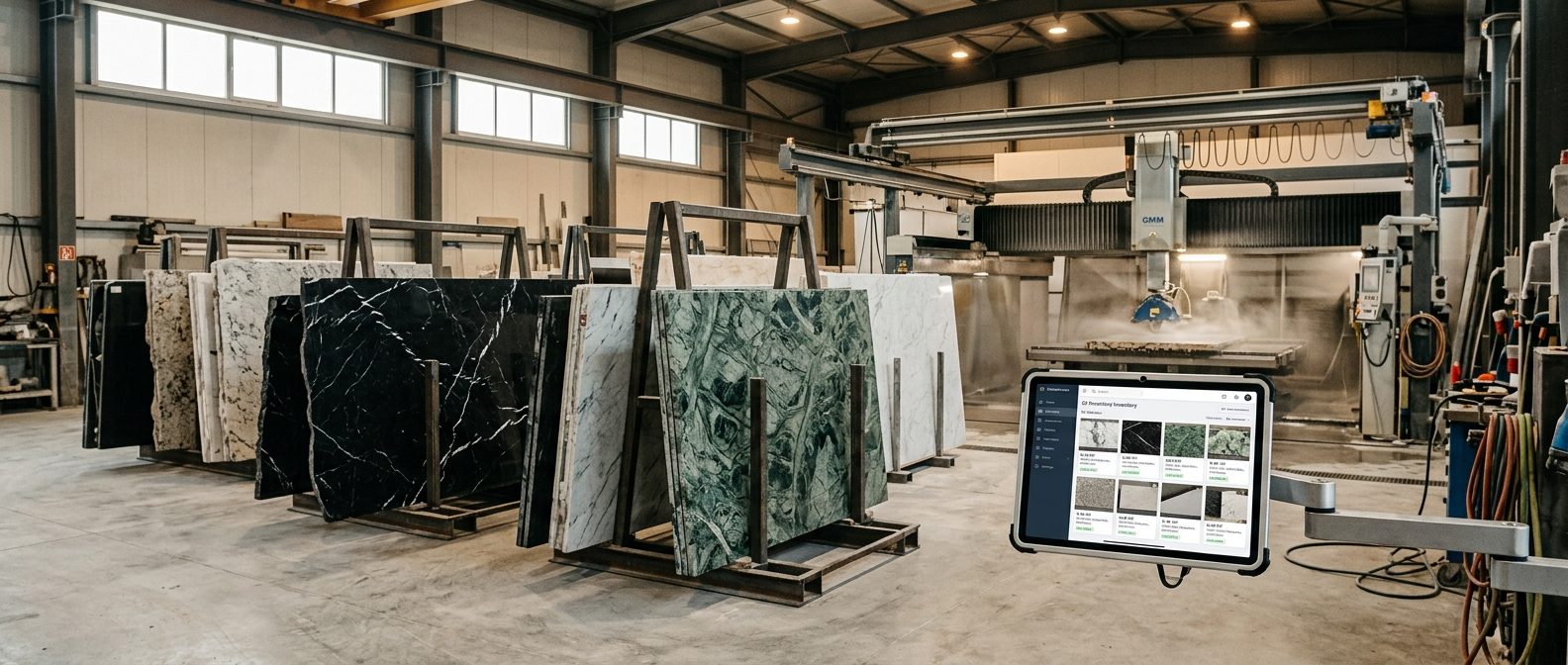
DDL captures every natural stone slab with a photo, dimensions, veining direction, and range specifications. Reservations run through the system instead of verbal handoffs. Remnants become visible before new material is ordered. When DXF files from digital templating are imported, slab assignment can be planned on-screen — instead of standing at the rack and estimating.
Explore Inventory ManagementTwo Decisions — One Direction
The templating system brings precision to the job site. It secures the geometry, eliminates transfer errors, accelerates the data flow into production. For complex contours — sink cutouts, curved vanities, floor transitions in historic buildings, or the interior cladding of a chapel — there is no alternative.
Internal digitalization brings precision to the operation. It secures the slab inventory, eliminates double reservations, makes remnants visible that would otherwise be forgotten. It acts at every quote, every project plan, every material decision — quietly, but measurably.
Both investments point in the same direction: away from approximations, toward reliable data. The difference lies in price and decision speed. One costs 30,000 euros and is decided within weeks. The other costs a fraction of that and takes years.
That is not a criticism. It is an observation that holds true in nearly every shop. And it can be changed — faster than most expect.
More on inventory management: Excel vs. Digital Slab Inventory — Why Stone Fabricators Are Making the Switch.
Questions about digitalization in your own operation: Jan Keller is available to talk.
Explore DDL Solutions
Ready to talk through the next step?
Jan Keller walks through how digitalization works in a stone fabrication shop — without shutting down operations, without the chaos of a full switchover. One conversation, 20 minutes.